
A marble mandir design for home ties together centuries of sacred tradition and mandir design corners in modern home interiors. If it’s marble, it surely becomes a focal point in the home, and grounds everyday life in devotion, craftsmanship, and lasting material strength.
Table of Contents
Marble has been the material of sacred spaces in India for centuries, and that choice has never really changed, neither in temples nor in homes. This list of amalgamations of trending ideas covers everything worth knowing before you plan a marble mandir design. Like current trends, design types for different spaces, Vastu principles, costs, and how to keep it looking its best over time.
Why is Marble Mandir Design So Popular in Indian Homes?
Indians have used marble in sacred architecture for centuries, with some of the earliest examples found in temples like the Dilwara Temples in Rajasthan. It was chosen for its association with purity over its appearance. That same belief carried naturally into homes. Marble does not attract termites, warp with humidity, or crack over time, its shine and strength hold up across generations, unlike wooden structures.
There’s also the practical side of using marble in puja mandir designs for daily worship:
- Marble does not absorb stains from oils, incense, or turmeric like wood does.
- Marble’s natural cooling properties and ability to bounce light softly evoke calmness. These two are the favourable properties for prayer and meditation.
- All of it, the history, and the low upkeep are why marble is the first choice when Indian families think about building a sacred corner at home.
Benefits of Choosing Marble Puja Mandir Design
Marble has held its place in sacred spaces for good reason. It is durable, low-maintenance, and carries a sense of purity that other materials simply do not. Below are the reasons why it is the preferred choice for home mandirs.
- It lasts for generations. Marble does not fade or wear out over time. A marble pooja mandir built today can easily be passed down to the next generation with the unchanged look or structure.
- Naturally cool surface. The nature of marble is cool, regardless of the season, which makes sitting near it during long prayer sessions genuinely comfortable.
- Vastu-friendly. In Vastu Shastra, marble is considered to contribute to evoking an ideal environment for divine energy.
- Easy to maintain. Marble does not stain easily. If you wipe it regularly with a soft cloth, it is enough to keep it looking clean. It is also resistant to heat and water.
- Each piece is one of a kind. The natural veining and patterns of marble mean every mandir is unique. No two pieces will ever look exactly the same.
- Works with any interior style. Marble can complement modern and traditional puja mandir designs.
- Highly customisable. A marble mandir design can be customised to your space, style, and spiritual requirements. As it can fit a compact apartment unit, it can similarly go befittingly with a large space as well.
- Holds its value. Since marble is a natural stone with a long lifespan and evergreen beauty, a well-carved marble mandir is a sound long-term investment for the home.
What are the Latest Marble Mandir Design Trends?
Marble mandir designs have moved well beyond the traditional carved temple look. Today’s options range from minimal wall-mounted units to backlit panels and brass-accented structures. These are the styles homeowners are actively choosing nowadays.
1. Abstract and Geometric Marble Mandirs
It is a growing segment for art-forward homeowners who want something that doesn’t look like a conventional temple structure.
2. Backlit Marble Mandir Designs
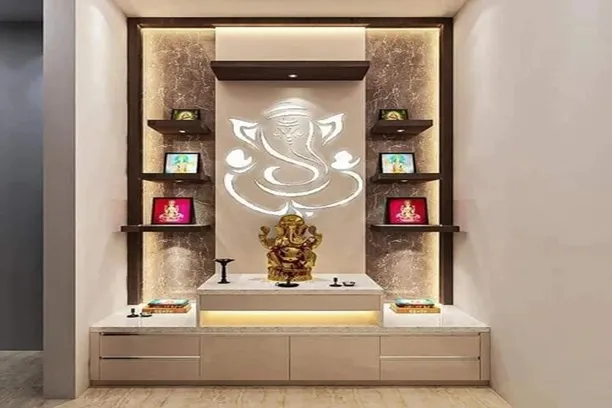
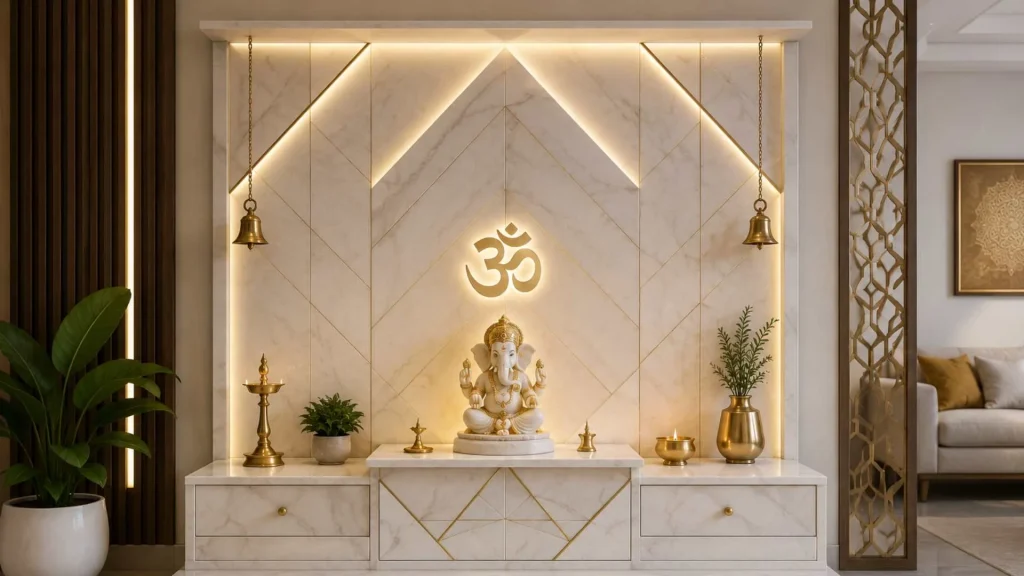
Backlit marble mandir for the home is among the most sought-after features in 2026. Warm white LED lighting secured behind the marble panel makes the stone’s natural veins glow. It stirs a calm and meditative atmosphere during prayers.
3. Brass and Gold-accented Marble Mandir Designs
The brass and gold-accented marble mandir has a hint of brass and gold in the detailing. Rather than all-marble designs, many people are now combining white marble structures with brass bells, brass diyas, and gold-finished detailing. This latest mandir design has a royal touch. The contrast between cool stone and warm metal works very well together.
4. Vietnam White Marble Mandir Designs
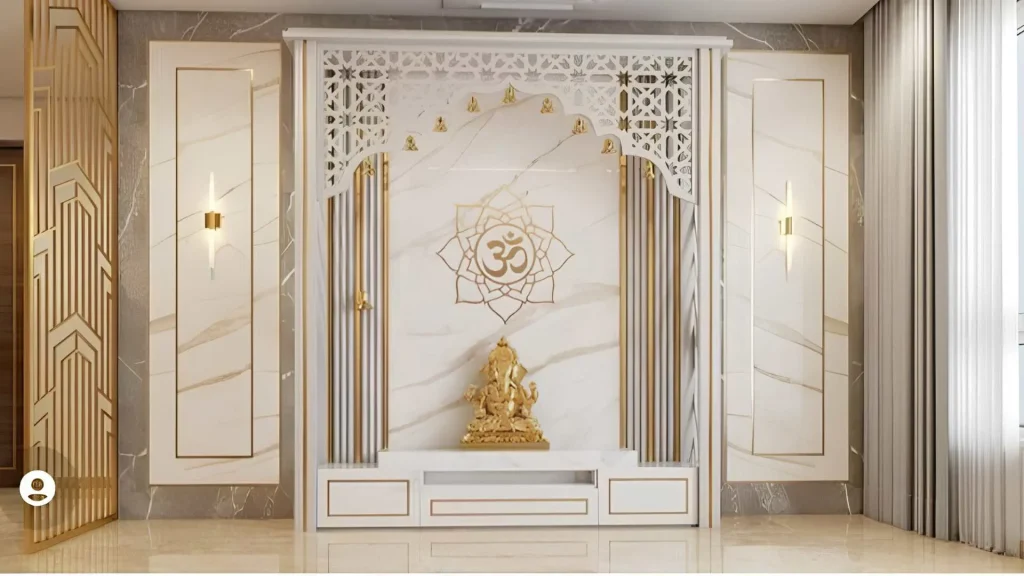
Vietnam’s white marble mandirs are gaining popularity. It is known for its bright tone and uniform texture, and is being increasingly chosen for contemporary interiors. Because of its modern, glossy appearance, it works as an alternative to the more traditional Makrana white.
What are the Types of Marble Mandir Designs for Home?
Not every home has the same space, layout, or design sensibility, which is why marble mandirs come in a range of structural forms. Knowing the different types helps you pick one that actually fits your home rather than working around it.
- Wall-mounted marble mandirs are fixed to the wall with a compact ledge supporting the idol and offerings. The structure occupies no floor space. And its decorative carvings along the edges fill the richness. This is now a go-to choice for apartment dwellers.
- Corner mandirs in marble are specifically designed to fit into room corners. This is a distinct design category that’s trending separately from wall mandir designs.
- Full pooja room in a simple marble design has a complete mandir unit made of marble. But walls, flooring, and the altar are all in matching marble, which is a growing trend in larger homes and dedicated pooja rooms.
- Marble and wood combination designs are hybrid puja mandir designs where marble forms the top or platform and wood handles the frame. These designs are quite popular right now, especially in mid-range homes.
- Traditional Rajasthani carvings are still going strong. Mandir pillars carved with floral motifs, miniature domes, and lotus patterns continue to be popular. It is true, particularly in homes that host regular gatherings. Here gold accents and white marble are put together for a celebratory feel.
- Minimalist home mandirs in marble are having a moment. Clean lines, smooth surfaces, and open shelves with little ornamentation are what many homeowners are going for right now. These designs have a simple platform for the idol and subtle recesses for incense and lamps. They become part of contemporary interiors.
- Jali or CNC-cut panel marble mandir works as a beautiful backdrop. Intricately carved marble jali panels placed behind the idol are a growing design choice. They put in depth, and permit light to pass through beautifully.
- A custom marble mandir with decorative back-wall panels has a focal point. A marble back-wall panel reshapes the wall behind the deity into an art piece. Carvings have different options like Om symbols, vines, or geometric patterns.
- South Indian temple-style marble mandir design for your home can be a great fit for your pooja mandir corner. This is inspired by Dravidian temple architecture with gopuram-style tops, tiered structures, and detailed stone carvings.
- Marble mandir designs with built-in storage come with drawers beneath the platform. You can store incense, wicks, and small utensils. Side cabinets are meant for keeping prayer books and brass items tidy. The storage is normally carved finely into the marble so it doesn’t obstruct the view entirely.
Marble Mandir Design for Different Spaces
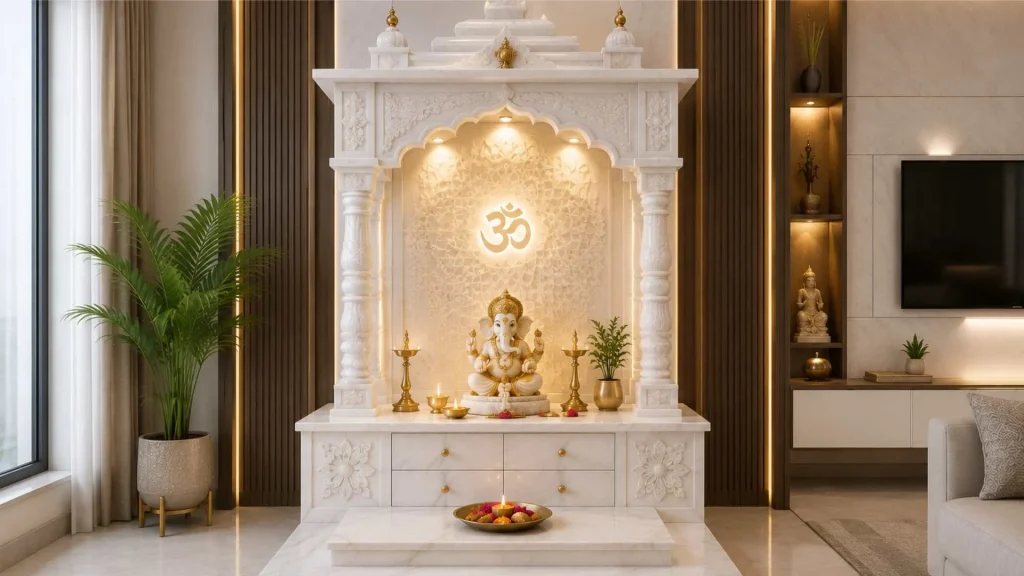
A mandir in a studio apartment calls for a completely different approach than one in a dedicated pooja room or a garden. Here is how the marble mandir design translates across different spaces and room types.
| Space | Best Design Type | Key Features to Consider |
|---|---|---|
| Dedicated Pooja Room | Full floor-standing marble mandir with pillars, domes, and carved backdrop | Matching marble flooring and walls, jali panels, brass bells, multi-tier shelves for multiple deities, LED backlighting behind the idol |
| Living Room | Medium-sized marble mandir with decorative back panel (preferably in north-east corner) | Refined design that aligns with complete decor, white marble paired with brass idols, bells, or diyas for beauty |
| Small Apartment / Flat | Wall-mounted marble mandir with compact ledge | Occupies no floor space, carved edges for detail, backlit marble panel to strengthen presence in smaller rooms |
| Corner Space | Corner marble mandir designed to fit snugly | Taller rather than wider proportions, built-in drawers for incense, diyas, and prayer books to maintain neatness |
| Bedroom / Study Nook | Simple marble mandir with flat base, clean back panel, small drawer | Compact and understated, keep in the northeast corner and cover when not in use |
| Large Villa / Bungalow | Grand floor-standing mandir with detailed carvings, pillars, and storage | Separate seating area for longer prayers, steps leading to idol platform, fully marble-clad pooja room possible |
| Office / Workspace | Small marble mandir with domes or subtle arches | White marble preferred, minimal detailing, wall-mounted units suit professional settings, easy to maintain |
| Garden / Outdoor Space | Small outdoor marble mandir within landscaped setting | Weather-resistant marble (e.g., Makrana), covered structure for protection, optional water feature nearby |
| Pooja Alcove / Wall Niche | Built-in marble mandir fitted into recessed wall | Backlit marble panel, highlighted sacred symbol or image behind the idol for richness in a limited space |
How Much Does a Marble Mandir Design Cost in India?
Marble mandir pricing in India varies widely depending on size, marble type, carving detail, and where you source it from. This section breaks it down so you know what to expect before you get a quote.
1. Marble Mandir Design Price by Size
Marble pooja unit prices vary based on size and detailing:
- Small mandir (2-4 ft): ₹25,000 – ₹60,000
- Medium mandir (5-7 ft): ₹70,000 – ₹1,50,000
- Large floor-standing mandir: Starts from ₹200,000 and can go significantly higher
2. Marble Mandir Cost Per Square Foot
The average marble mandir cost per sq ft ranges between:
₹2,000 – ₹8,000+ per sq ft
The final rate depends on carving complexity, polish quality, marble grade, and custom detailing.
₹2,000 – ₹8,000+ per sq ft
The final rate depends on carving complexity, polish quality, marble grade, and custom detailing.
3. Key Factors That Affect Marble Mandir Unit Cost
Marble Type
- Makrana White Marble Mandir Design – It is a durable and traditional, mid to premium-priced mandir design.
- Vietnam White Marble Pooja Unit – It accounts for budget to mid-range, smooth, uniform finishes.
- Italian Marble Mandir Design – This mandir design falls into a premium-to-luxury segment.
Size & Structure
- Wall-mounted mandirs are more affordable than large floor-standing temple-style units.
- Larger dimensions increase material and labour costs.
Carving & Design Complexity
- Intricate hand-carved pillars, domes, and jaali work increase pricing.
- Minimal or modern designs with clean surfaces are more economical.
Customisation
- Special engravings, family motifs, symbolic carvings, or bespoke sizing add to the cost.
Add-ons
- LED backlighting
- Gold leaf or brass detailing
- Semi-precious stone inlay
- High-gloss polishing
4. Additional Costs to Consider
Base quotes normally exclude the following:
- Installation charges
- Transport and packaging
- GST
- On-site fixing materials (cement, adhesives, labour adjustments)
5. Production Timeline
Handcrafted marble mandirs take around 3-5 weeks to manufacture. The manufacturing depends on carving detail and finishing work. Larger or heavily customised temple-style structures may require more time.
6. Marble Type vs Appropriate Budget
| Marble Type | Cost Range | Suitable For |
|---|---|---|
| Vietnam White | Budget to Mid-range | Modern apartments |
| Makrana White | Mid to Premium | Traditional home mandirs |
| Italian Marble | Premium to Luxury | Villas, large pooja rooms |
7. Budget Planning Tips
- As a homeowner, you must request a detailed written quotation separating stone cost, carving, finishing, GST, transport, and installation.
- If you want to work within a budget, you should consider a marble wall mandir or a marble-top unit with wooden storage below.
- You should definitely inspect the actual marble slab before final approval, as tone and veining vary naturally.

Maintenance Tips for Marble Mandir Design for Home
Marble is one of the easier materials to maintain, but a few common mistakes, like using the wrong cleaner, letting spills sit, and skipping sealing. All this can dull its surface over time. These tips will help you keep it looking clean and intact for years.
- You can prevent ash and oil buildup by dusting the mandir with a soft cloth. Oil, water and haldi spills must be wiped immediately because marble is porous and stains easily.
- When you clean the carvings, you must do it with soft carvings.
- Clean weekly with mild, non-acidic soap and lukewarm water. Also, dry thoroughly to prevent water marks.
- You should not use vinegar, lemon, bleach, ammonia, or harsh scrubbers.
- For light stains, you can apply a baking soda paste, leave overnight, and gently clean.
- You should avoid placing sharp or heavy objects directly on the surface.
- It is important to polish every 3-6 months to maintain shine.
- Seal the marble every 1-2 years to block moisture absorption and staining.
- Keep away from prolonged direct sunlight.
- You should keep inspecting periodically for cracks or chips and repair early to prevent further damage.
Start Your Home Interior Designing Journey with Opalspace
A marble mandir design is one of the few things in a home that genuinely serves two purposes well. One that creates a sincere space for daily worship and, at the same time, brings forth an unaffected quality to the interiors that no other material quite matches. Marble adapts to the space, the budget, and the design type with no compromise on its core appeal. Every decision around a marble mandir deserves careful thought. Only an experienced professional can plan and execute it flawlessly.
Opalspace handles all of it for you. Our interior design services cover everything from the initial concept and space planning to material selection, mandir design, and complete installation. So, you never have to piece it together from multiple vendors. If you are planning a new home, a renovation, or simply want to design a pooja corner that showcases your taste and traditions, reach out to our team, and we will take it from there.
Opalspace handles all of it for you. Our interior design services cover everything from the initial concept and space planning to material selection, mandir design, and complete installation. So, you never have to piece it together from multiple vendors. If you are planning a new home, a renovation, or simply want to design a pooja corner that showcases your taste and traditions, reach out to our team, and we will take it from there.
FAQs
1. Which marble is best for mandir design?
Makrana white marble is widely considered the best choice for mandir design because of its durability, fine grain, and traditional association with sacred architecture. Vietnam white marble is a good budget-friendly alternative with a clean and modern finish. Italian marble fits with premium or luxurious design preferences.
2. What is the ideal direction for the marble mandir?
According to traditional Vastu principles, the north-east corner of the home is the most auspicious direction for placing a mandir, as it is believed to increase positive energy. If the north-east isn’t available, placing the mandir facing east or north is generally recommended.
3. Is a marble mandir good as per Vastu?
Yes, marble mandirs are considered Vastu-friendly because marble’s reflective surface and light tones are believed to support calm, spiritual energy in a prayer space. If you go for it, pick a light marble (like white or cream) and place it correctly. So that it can help maintain harmony and focus during prayers.
4. What is the cost of a marble mandir in India?
In India, a small marble mandir (2-4 ft) normally ranges from ₹25,000 to ₹60,000, a medium mandir (5-7 ft) around ₹70,000 to ₹1,50,000, and larger temple-style units from ₹2,00,000 upwards. Custom designs with detailed carving and premium marble can cost significantly more based on size and craftsmanship.
5. Can a marble mandir be used in small flats?
Yes, marble mandirs can be used in small flats through compact formats like wall-mounted or corner mandirs that occupy minimal floor space. Thoughtful design choices like lighter finishes, slim profiles, or integrated storage help retain openness and preserve spiritual functionality.