Table of Contents
In 2026, kitchen ceiling design in India has shifted towards minimal layouts, lighting-led POP work, and zone-based drops.
What is the Best Kitchen Ceiling Design in 2026?
Why Kitchen Ceiling Design Matters More Than You Think?
- The ceiling is what controls how light lands across the cooking counter, the sink, and the prep zone.
- Smoke, grease, and humidity rise, and a designed ceiling with the right material handles those far better than raw plaster.
- Here is an important point: builder-floor apartments with finished false ceilings command measurably higher rent than identical units without ceilings.
Top Kitchen Ceiling Design Styles for 2026
1. Clean False Ceiling with Soft Edges
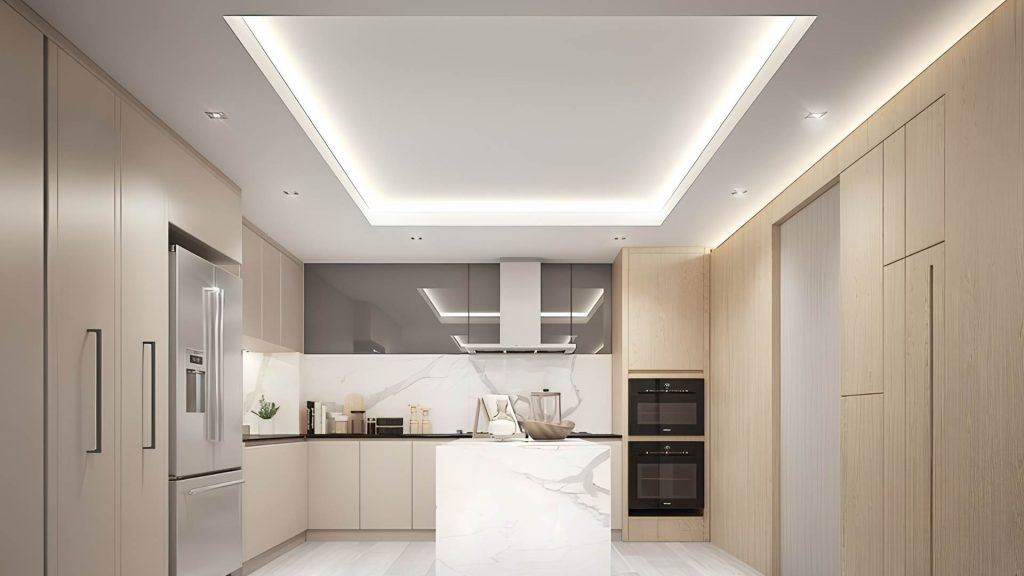
A flat, smooth POP surface with a rounded border transitions with no sharp 90° corners, no visible joints. This is the go-to kitchen ceiling design for homeowners who want a finished look without heavy ornamentation.
- Smooth plaster finish preferred over textured finishes.
- Pair naturally with neutral paint tones and concealed lighting strips.
- Rounded corners at the wall-ceiling junction soften the entire room.
- No maintenance-heavy moulding to repair over time.
2. Minimal Kitchen Ceiling Design
One level. One material. No ornamentation. The minimal flat ceiling is the most universally applicable kitchen false ceiling design in the market right now.
- Single-plane POP or gypsum board ceiling with zero surface detailing.
- Lighting placement alone carries the full design load.
- Reversible in most gypsum installations, relevant for tenants.
- Works across every kitchen size and layout type.
3. Layered Plus Minus Ceiling Design for Kitchens
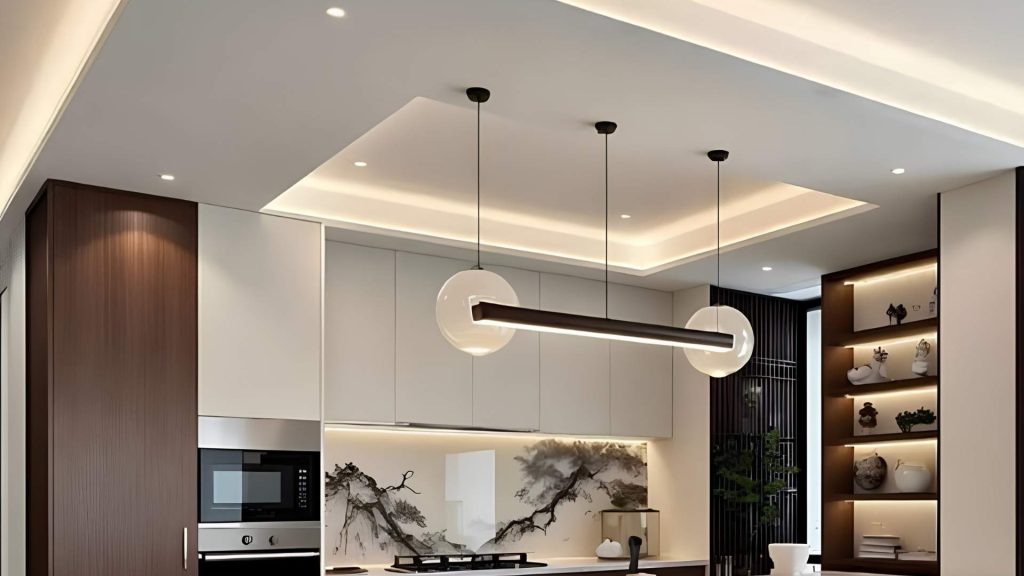
The plus-minus ceiling uses two levels, one raised, one dropped. The gap between layers holds LED strips and defines kitchen zones. This is the single most popular down ceiling design for kitchen renovations in Delhi NCR right now.
- Upper flat layer sits flush with the main ceiling line.
- Lower dropped section frames the cooking or dining zone.
- LED cove strips placed between the two layers deliver ambient depth.
- Works horizontally or as a perimeter-based drop.
4. Simple Ceiling with Lighting Focus
No POP complexity. No layering. The entire design investment goes into light placement, and it delivers.
- Flat or single-drop ceiling with deliberate spotlight or cove placement.
- Spotlight clusters, track lights, or cove lighting act as the centrepiece.
- Deliberate lighting placement builds depth, no POP complexity is needed.
- Three light types in one kitchen. Task spots over counters, ambient cove above the island, accent under cabinets.
5. False Ceiling Design for Larger Kitchens
Large kitchens benefit most from zone-based ceiling layouts.
- Divide the cooking zone, prep zone, and dining corner into distinct ceiling sections.
- Use beam-style drops or recessed panels for each zone.
- POP with wooden laminate strips works well as a material mix.
- Different ceiling heights signal different functions.
6. Geometric Pattern Ceiling
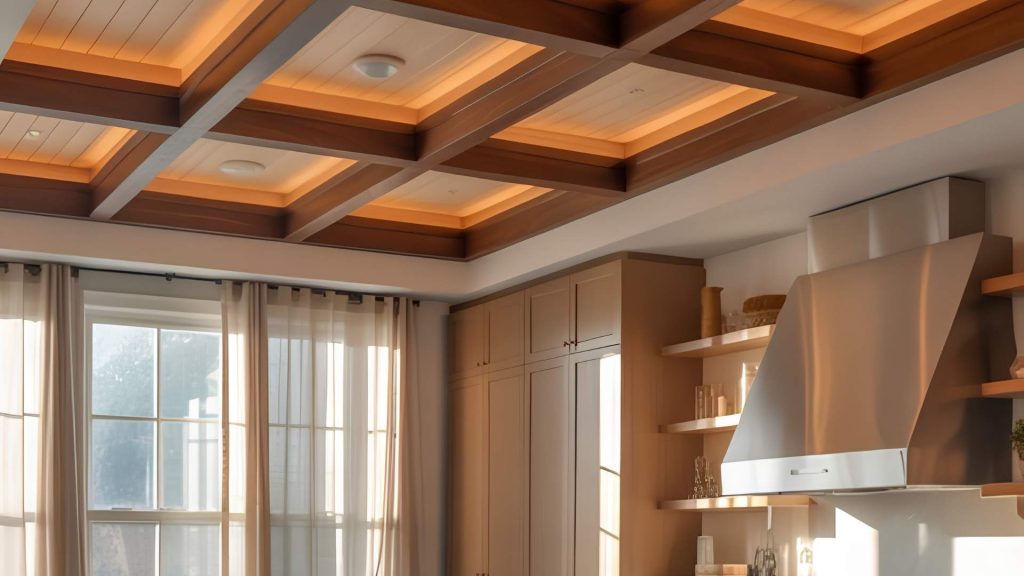
Structured, bold, and unmistakably intentional. Geometric kitchen ceiling design uses hexagonal, triangular, or grid-cut POP panels to bring a contemporary industrial edge to the space.
- Hexagonal or square grid panels cut into the POP surface.
- Bold patterning reads well in kitchens with matte black fittings and stone countertops.
- Keep pattern work to one ceiling zone, above the island or the primary work counter.
- Two-tone paint contrast between panel and field amplifies the geometry.
7. Floral Ceiling Design for the Kitchen
Moulded POP or CNC-cut panels bring floral motifs to the ceiling. A classy kitchen ceiling design route for traditional and transitional Indian homes.
- Restrict floral detailing to one panel zone, above the island or the dining corner.
- White-on-white paint keeps the motif refined without visual noise.
- Two-tone contrast (off-white field, broader accent on the motif) is the bolder play.
- CNC-cut gypsum panels deliver sharper detail than hand-moulded POP.
8. Curved False Ceiling Design
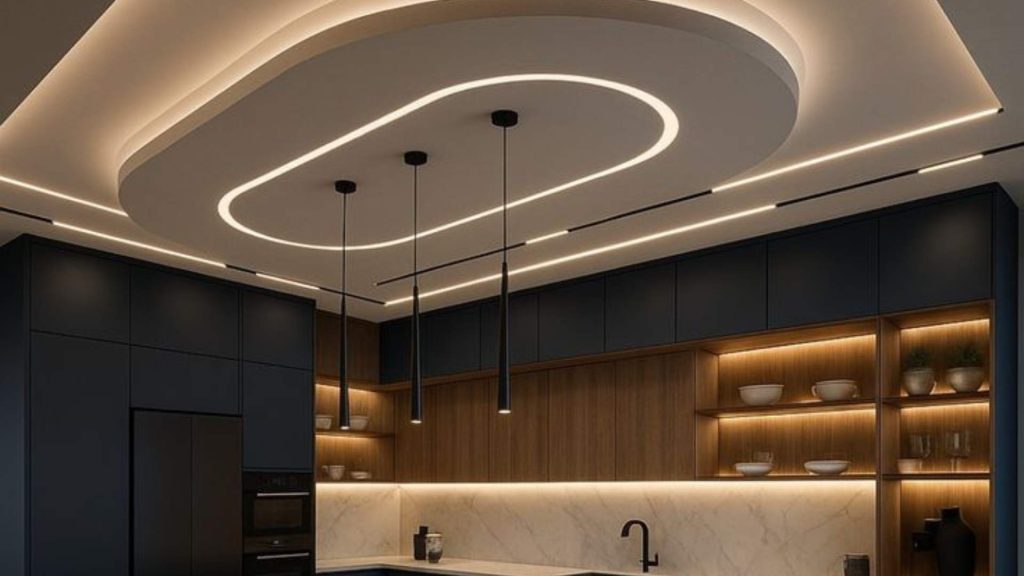
Arched drops and curved perimeter ceilings replace the standard 90° corner. The result is a kitchen that looks softer, more spatial, and more resolved.
- Curved perimeter ceiling arched away from walls instead of meeting them at a hard angle.
- No additional decor needed. The ceiling geometry does all the work.
- Requires a skilled POP contractor, not suitable for DIY or fast timelines.
- Works as a partial curve over one zone rather than a full-room application.
9. POP Arches for Soft Transitions
This is not a full ceiling. It is a transition design element. A POP arch at the kitchen entry or between the kitchen and dining area frames the boundary without a hard wall.
- Arched POP detailing sits at the kitchen opening or passage point.
- Height and width of the arch are calibrated to the opening dimensions.
- Adds architectural structure without additional square footage.
10. POP Ceiling with Recessed Lighting
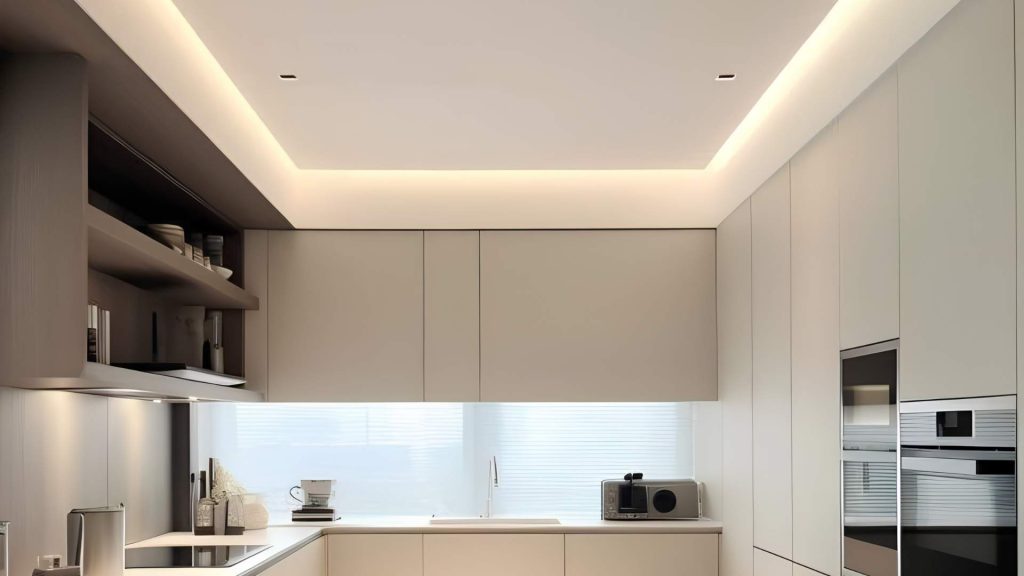
Recessed spotlights sit flush inside the POP frame. No exposed fixture, no wasted ceiling height. This is the most technically reliable down ceiling design for a kitchen in the Indian market.
- Spotlights spaced every 3-4 feet deliver consistent, glare-free task lighting.
- Warm white for cooking zones, neutral white for prep counters.
- POP frame conceals all wiring, driver boxes, and conduits.
- Dimmable drivers allow the kitchen to shift from work mode to dining mode.
11. Subtle POP with Neutral Finishes
Thin-border POP frame. No paint contrast. No heavy moulding. Restraint is the design choice here, and in 2026, this is one of the fastest-growing unique kitchen ceiling design directions in urban India.
- Narrow POP border around the ceiling perimeter.
- Matte or off-white finish across the full surface, no colour break.
- No moulding detail, the geometry of the frame does the work.
- Neutral-finish POP demand is growing sharply across Delhi NCR in 2026.
How to Choose the Right Kitchen Ceiling Design for Your Home
- Check ceiling height first. As interior design professionals, we often recommend starting with lighting and ceiling height before selecting any false ceiling design. Below 9ft: go flat or single-drop. At 9ft and above: layered or curved ceilings are the right territory.
- Map your lighting needs. Task lighting versus ambient lighting determines POP cut placement and spotlight density.
- Match the kitchen layout. Parallel, L-shaped, and island kitchens each have specific ceiling zone requirements. The ceiling must respond to the layout, not ignore it.
- Set a material budget clearly. POP costs the least per sq ft. Gypsum sits mid-range. Wood false ceilings run the highest. Know the number before the contractor arrives.
- Account for ventilation. Map chimney placement and exhaust duct routes first, these constrain ceiling zone boundaries and determine where drops are possible.
- Align with the overall interior. The ceiling must align with the cabinetry finish and the floor tile. Mismatched finishes make a kitchen read as unplanned
How Opalspace Can Help You Design the Perfect Kitchen Ceiling
At Opalspace, we go beyond ceilings. We provide services like modular kitchen interiors, living spaces, bedroom layouts, and complete home interiors. Your kitchen needs a ceiling that actually works. Our team at Opalspace is ready to plan it with you.