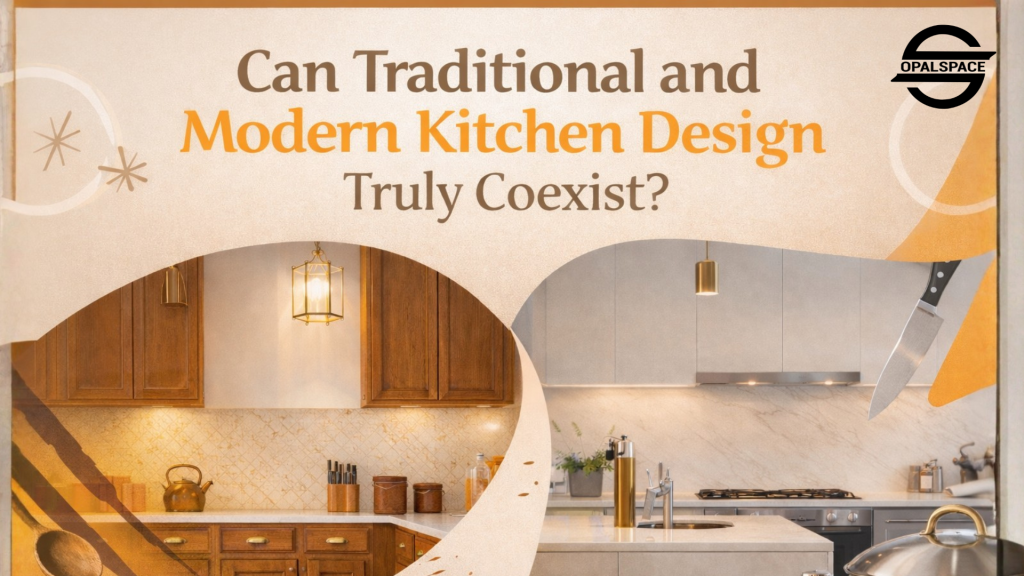
You do not need to pick between traditional and modern kitchen design anymore. Our well-considered formulae will show you how to mix these two eras smartly.
Table of Contents
Why would anyone want a mix of traditional and modern kitchen interior design in the contemporary era? What is it they find missing in a purely modern approach? Not so surprisingly, I would be on their side too, since there’s nothing wrong but a real thoughtful reason behind this idea. Given the advancement in our living standard, we need to move ahead and welcome modernity. But it’s nowhere said that to accept the contemporary, you ought to lose authenticity and traditional touch.
| Element | Modern Kitchen | Traditional Kitchen |
|---|---|---|
| Premises | Minimalism, function, clean lines | Ornamentation, organic design |
| Cabinetry | Flat-panel, handle-less, polished finishes | Raised-panel, decorative mouldings, framed |
| Materials | Engineered quartz, stainless steel, concrete | Natural stone, stained wood |
| Colour Palette | Monochromatic neutrals (white, black, gray) | Warm neutrals with muted accents |
| Lighting | Recessed lights, geometric pendants, track lighting | Chandeliers, lantern pendants, wall sconces |
| Decor & Feel | Sparse, sculptural, mess-free, classy | Detailed, furnished, layered |
How to Blend Old and New in a Kitchen?
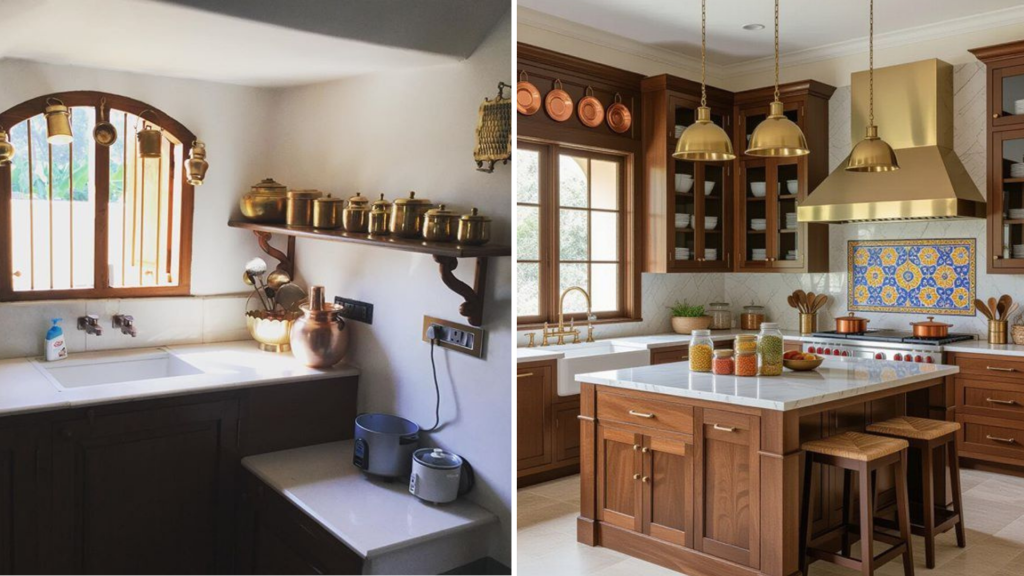
- You should do the kitchen interior with one dominant style (80%) and accent with the other (20%).
- In order to tie the disparate elements together, make sure you use a consistent neutral colour palette.
- And it should be like that there’s the supremacy of traditional design over modern, only to restore the balance.
- Also, when you go for the material-selection, just know that you need to incorporate the same material for both types of designs. Because that takes care of design flow.
What are Some Key Areas to Focus in Your Kitchen Interior Design?
1. Cabinetry
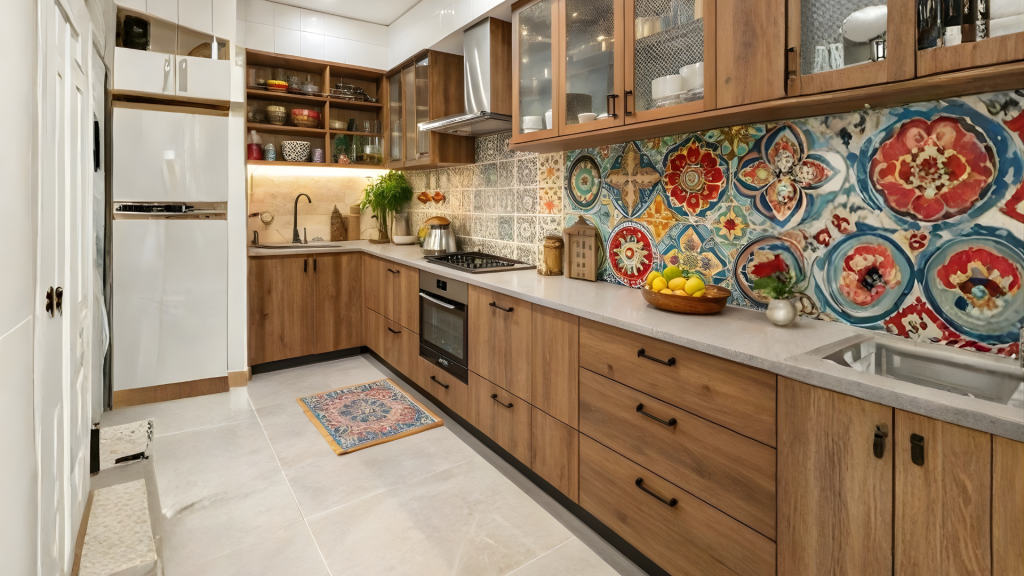
- You can either go for 80% traditional cabinetry (e.g., Shaker, raised-panel) and the rest of it modern. Or you can go vice-versa (e.g., flat slab).
- Try applying the opposing 20% style here. A modern island grounds traditional perimeter cabinets, and a traditional island warms up a modern kitchen.
- For a guaranteed harmonious mix, you should be using Shaker-style cabinets as your primary door. Their simple, recessed panel is naturally transitional.
- This is non-negotiable. It is important to paint or stain all cabinets (traditional and modern sections), within the same colour family.
- You can install modern hardware (bar pulls, edge pulls) on traditional doors, or rather select traditional hardware (bin pulls, cup handles) on modern slab doors to visually link the styles.
- If not the island, then decide on the secondary style to a single feature. Like a floor-to-ceiling pantry unit, a built-in hutch, or a section of open shelving.
- It is important to understand that you never have to mix multiple, equally dominant door styles throughout the kitchen.
2. Countertops & Backsplash
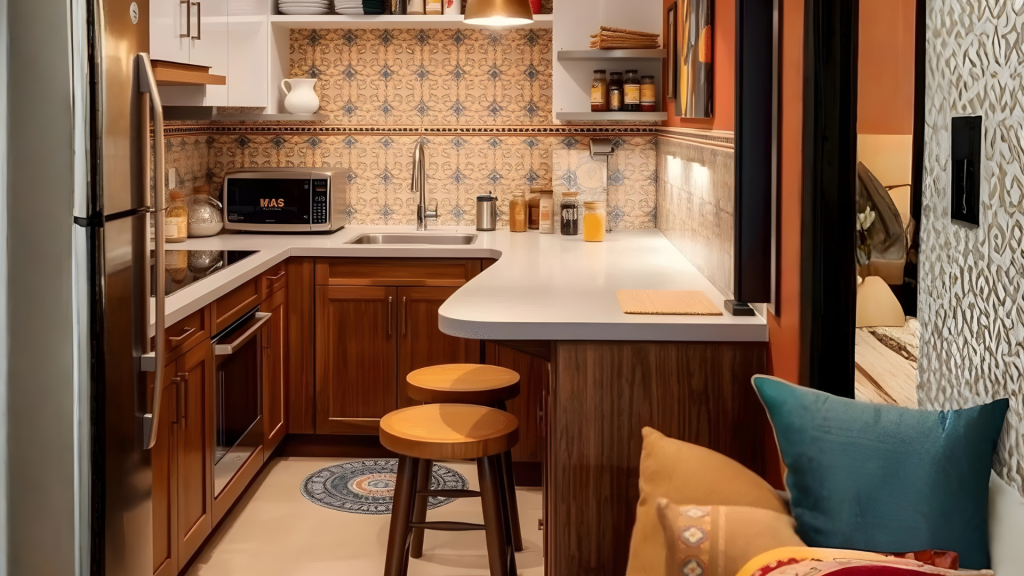
- You need to choose if the kitchen countertop or the backsplash should overpower, and let the other play a supporting, neutral role.
- You can use a traditional material in a modern way (e.g., Carrara marble subway tile in a herringbone pattern) or a modern material with a traditional way (e.g., quartz countertop with a classic ogee edge).
- You can easily use the backsplash for pattern and detail, especially behind the range or hood. And you can still keep countertops simple.
- A solid and neutral countertop (like polished granite, quartz in a solid colour, or butcher block) gives a strong base to traditional and modern backsplash and to cabinet styles too. This aligns with one another.
- You need to pull a secondary or accent colour from your countertop up into the backsplash tile (or vice-versa). This way you can connect the two surfaces visually.
- You can pair a bold, veined or busy countertop with solid-coloured (like large-format ceramic or glass). In converse, a busy backsplash pattern needs a quiet, solid countertop.
3. Hardware & Fixtures
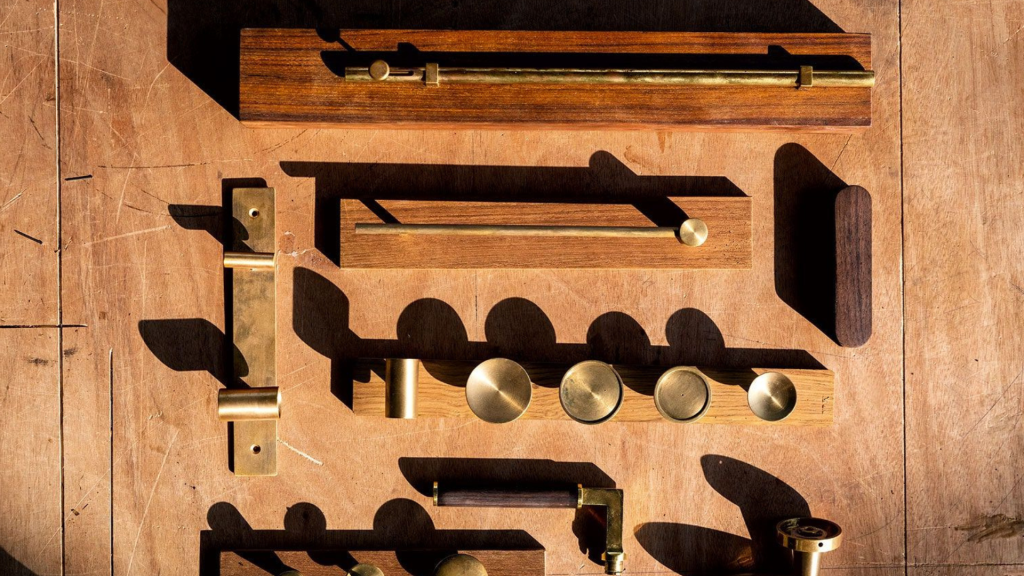
- You should go with installing modern hardware on traditional cabinetry (e.g., long bar pulls on Shaker doors) or traditional hardware on modern cabinetry (e.g., bin pulls on slab doors).
- It is helpful to select one dominant metal finish (e.g., brushed nickel, matte black, unlacquered brass) for all hardware and fixtures (faucet, cabinet pulls, lighting) to maintain a flow.
- You should incorporate gooseneck faucets in a modern finish. Or to keep it sophisticated, single-lever faucets in a traditional finish like polished brass.
- High-quality, solid-feeling hardware with a clean profile (even if traditional in style) reads as everlasting rather than dated.
- You can use a different, but complementary, finish for smaller accents like pot filler or appliance handles. Provided the primary hardware finish takes the dominant role.
4. Furniture & Lighting
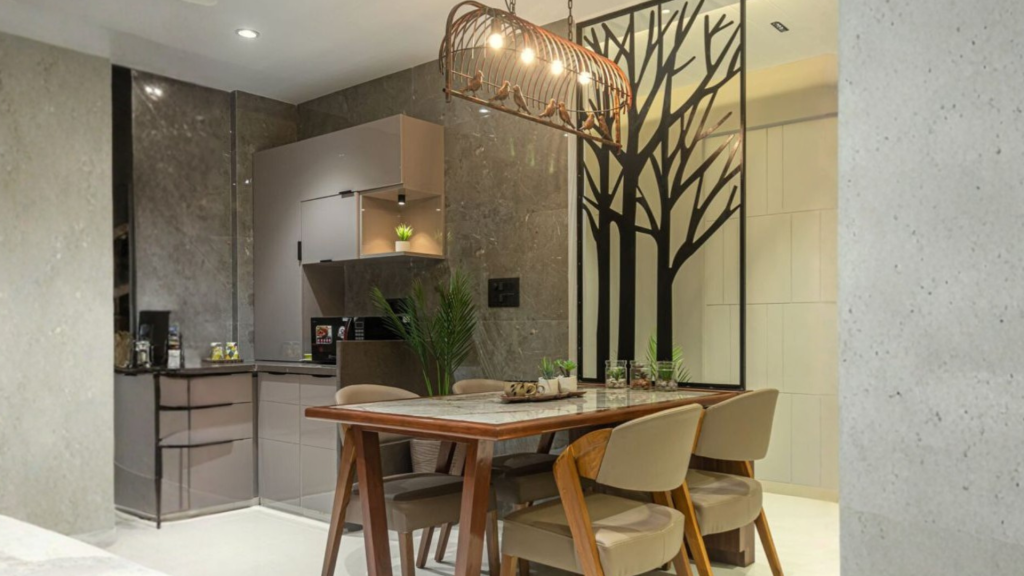
- Since we are considering traditional along with modern interior design, you can hang a traditional chandelier (e.g., crystal, lantern) over a modern kitchen island. Or modern pendants (e.g., glass globes, geometric shapes) over a farmhouse table for contrast effect.
- You can introduce a traditional wood table, a vintage hutch, or upholstered counter stools to warm up a modular kitchen.
- How about pairing a modern waterfall island counter with stools? The one that features traditional turned legs or upholstered seats. Or maybe place slim, polished minimalist stools at a rustic, farmhouse-style island.
- It is good to mix modern recessed lighting (ambient) with a traditional statement fixture (focal). You can add under-cabinet task lighting for a balanced, practical scheme.
- A traditional patterned or textured rug under a modern kitchen table makes the area feel more settled, with added colour.
- To counteract the overpowering visual presence of a traditional furniture piece, you can go for airier, lighter modern elements nearby.
5. Flooring
- To underwhelm the effect of other mixed elements, natural stone (like limestone), wide-plank hardwood, or large-format porcelain tiles in a neutral tone are the best.
- Apply a modern treatment to a traditional material. You can use classic hardwood, but with a wire-brushed, matte finish and extra-wide planks which are laid in a simple linear pattern.
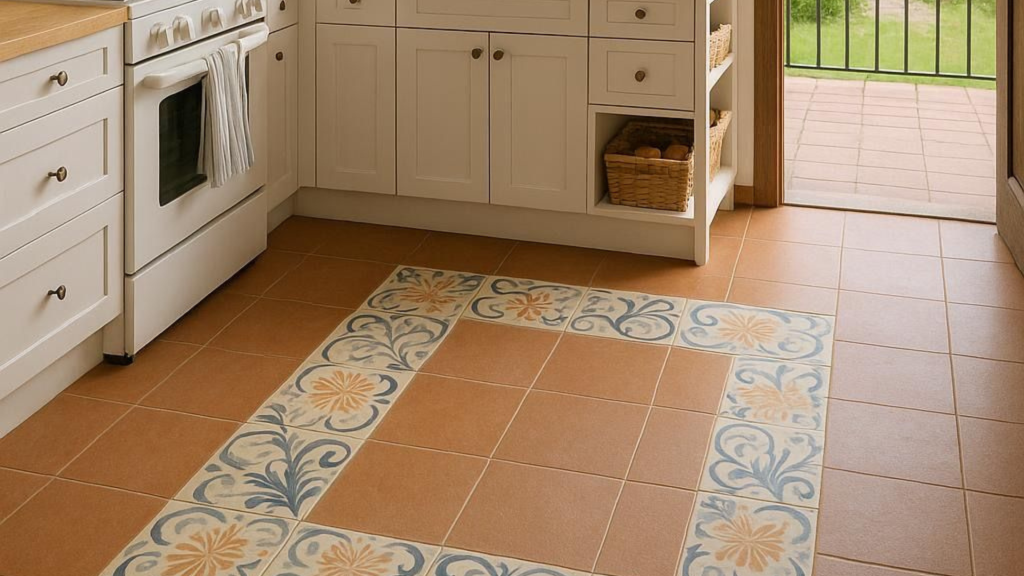
- In a highly modern kitchen, a traditional patterned floor (like herringbone wood or cement tile) provides the crucial homely feel and texture. It helps restore the balance between a neat look and preventing a cold, sterile feel.
- The subtle uniformity of a minimalist modern floor gives ease to the eyes. It guarantees that the contrasting traditional pieces are perceived as fancy statements of style.
- You should use a traditional vintage-style or patterned rug (e.g., Persian, Turkish) in a modern kitchen’s seating area. It will instantly add heritage and homeliness.
- By picking up a neutral or wood tone in cabinetry or countertops, the floor colour gets connected to the overall kitchen palette.
What are the Common Mistakes and How to Avoid Them in Your Kitchen Design?
To successfully mix traditional and modern kitchen interior designs, you need to work on some significant mistakes. Because these mistakes push the imbalance in the entire space.
1. A Disjointed Theme
Problem: When you select individual items because they are ‘traditional’ or ‘modern’ in isolation, even without considering if they align or not. This leads to a collection of mismatched pieces that lack harmony.
Solution: What you need to do is to adhere to a strict colour palette and material story. Try and use no more than three main materials and a flowy colour scheme throughout. This will give you a unified backdrop that allows different styles to converse peacefully.
Solution: What you need to do is to adhere to a strict colour palette and material story. Try and use no more than three main materials and a flowy colour scheme throughout. This will give you a unified backdrop that allows different styles to converse peacefully.
2. To Distribute Styles Evenly (50/50 Split)
Problem: When you apply traditional and modern elements in equal visual weight, doing this induces competition among them. It leaves the viewer unsure where exactly to stop, and gets overwhelmed.
Solution: In order to not do so, you should follow the 80/20 principle. Designate one style as the dominant foundation (applied to large, foundational elements like cabinetry and layout) and use the second as a deliberate accent (applied to focal points like the island, lighting, or hardware).
Solution: In order to not do so, you should follow the 80/20 principle. Designate one style as the dominant foundation (applied to large, foundational elements like cabinetry and layout) and use the second as a deliberate accent (applied to focal points like the island, lighting, or hardware).
3. When You Ignore Architectural Context
Problem: In case when a style is imposed that fights the natural architecture of the home (e.g., ultra-modern, glossy cabinets in a century-old craftsman bungalow), this creates a permanent state of visual conflict.
Solution: Let the room’s existing architecture anchor your dominant interior choice. In a period-home design, you can use traditional as the 80% base and layer in modern accents. In a new-build home design, you can use modern as the base and add traditional character through furnishings and finishes.
Solution: Let the room’s existing architecture anchor your dominant interior choice. In a period-home design, you can use traditional as the 80% base and layer in modern accents. In a new-build home design, you can use modern as the base and add traditional character through furnishings and finishes.
4. Overlooking Scale and Proportion
Problem: It is problematic when you pair heavy, ornate traditional furniture. Especially with spindly modern stools or vice-versa because it generates imbalance in the overall ambiance.
Solution: Check if all the elements, regardless of style, share a compatible visual weight and scale. A substantial farmhouse table needs substantial seating. A classy compact waterfall island can be paired with lighter, linear stools.
Solution: Check if all the elements, regardless of style, share a compatible visual weight and scale. A substantial farmhouse table needs substantial seating. A classy compact waterfall island can be paired with lighter, linear stools.
5. Neglecting the Unifying Role of Lighting
Problem: When you use lighting that is purely decorative and period-specific, and do not consider how it provides overall ambient light, it leads to a poorly lit space where the entire design feels segregated too.
Solution: In this problem, you should employ a layered lighting plan. You should use integrated, modern ambient lighting (like recessed or track lights) for overall illumination. Then, layer in stylistic statement fixtures (like a traditional chandelier or modern pendants) as focal points.
Solution: In this problem, you should employ a layered lighting plan. You should use integrated, modern ambient lighting (like recessed or track lights) for overall illumination. Then, layer in stylistic statement fixtures (like a traditional chandelier or modern pendants) as focal points.
How Can Opalspace Help You?
When you mix traditional and modern kitchen designs, it enables you to enjoy a classic look with the convenience of new technology. Opalspace assists you in picking the right materials and layouts so these two styles work together effectively. We handle the entire home interior design and installation process to ascertain your space is completely useful, organized, and suited to your needs.
FAQs
1. What defines a modern kitchen interior design for an Indian home?
A modern Indian kitchen interior design emphasizes clean lines, sleek cabinetry, and a minimalist palette. It integrates smart appliances and efficient layouts, often using materials like quartz or granite, while still considering space for essential Indian cookware and ventilation.
2. How can I achieve a successful mix of traditional and modern kitchen interior style?
To blend traditional and modern styles, use a modern layout and sleek finishes as your base. Then, layer in traditional elements like handcrafted cabinet jaalis (latticework), rustic textured backsplashes, or brass/polki hardware. This creates a balanced, culturally rich space that is highly functional.
3. What are key considerations for storage in an Indian kitchen interior?
Indian kitchens require specialized storage. Opt for modern deep drawers for pots, tall units for trays, and dedicated masala dabbas (spice box) and grain containers. A pull-out unit near the stove for oils and daily spices is a modern solution for a traditional cooking workflow.
4. Which color schemes work best for a modern Indian kitchen?
For a modern look, neutral backdrops like white, grey, or beige are popular. You can then inject vibrancy through a traditional colourful backsplash, textured wood accents, or high-gloss cabinets in bold hues. This allows for a mix that feels contemporary yet warm.
5. Is an open kitchen layout suitable for an Indian kitchen interior given the cooking style?
Yes, with careful planning. A modern open concept can work by incorporating a powerful chimney, using partition shelves or a breakfast bar as a subtle divider, and choosing easy-to-clean materials for a backsplash and countertop to manage aromas and grease effectively.