This guide filters the essential principles of smart small-space design. You’ll learn how to plan a 1000 sq. ft. layout that prioritizes flow, integrates multi-use zones, and employs visual ideas to maximize the space and luxurious feel.
Table of Contents
In current times, the 1000 sq.ft. home design floorplan has become a design base consideration, especially in cities like Delhi NCR. It is a scale that rewards smart choices and thoughtful planning, and thus delivers the perfect balance between ease of movement and capacity. Therefore, this is about strategically unlocking the full potential of a space to make it appear surprisingly expansive, and not about overcoming limits alone.
However, achieving this balance requires tackling a distinct set of urban spatial challenges, where residents happen to encounter common frustrations like compromised storage, lack of designated zones, and the feeling of a cluttered environment despite how well the place is managed within the given layout.
However, achieving this balance requires tackling a distinct set of urban spatial challenges, where residents happen to encounter common frustrations like compromised storage, lack of designated zones, and the feeling of a cluttered environment despite how well the place is managed within the given layout.
The 5 Foundational Design Principles for 1000 sq. ft. Home Design
These five principles form the essential framework for an efficient, and comfortable living environment within a 1000 sq. ft. home.
1. Open Floor Plans with Zoning
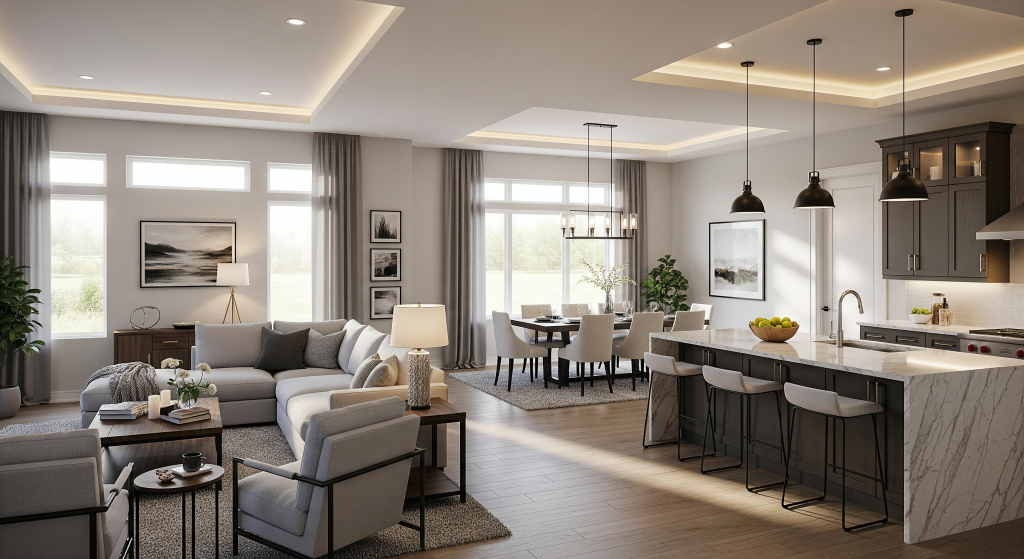
- What: Merge living, dining, kitchen. Use furniture, rugs, or level changes to create distinct zones without walls.
- Why: Makes space feel larger, brighter, and improves airflow. Prevents a ‘boxy’ feel.
2. Vertical Storage
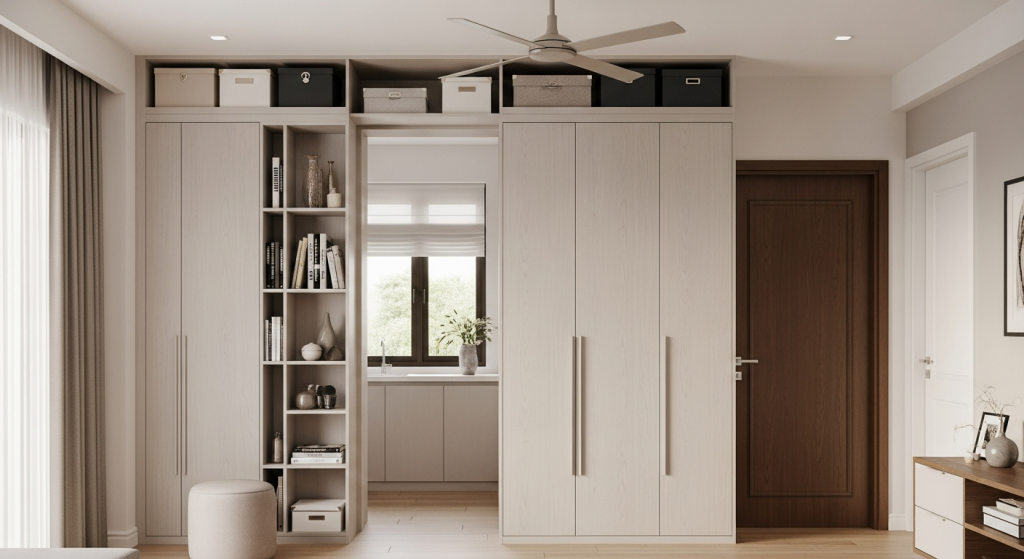
- What: Use full-height wardrobes, cabinets, and tall shelving. Utilize space above doors and windows.
- Why: Frees up crucial floor space. Reduces clutter. Draws the eye up, making rooms feel taller.
3. Circulation
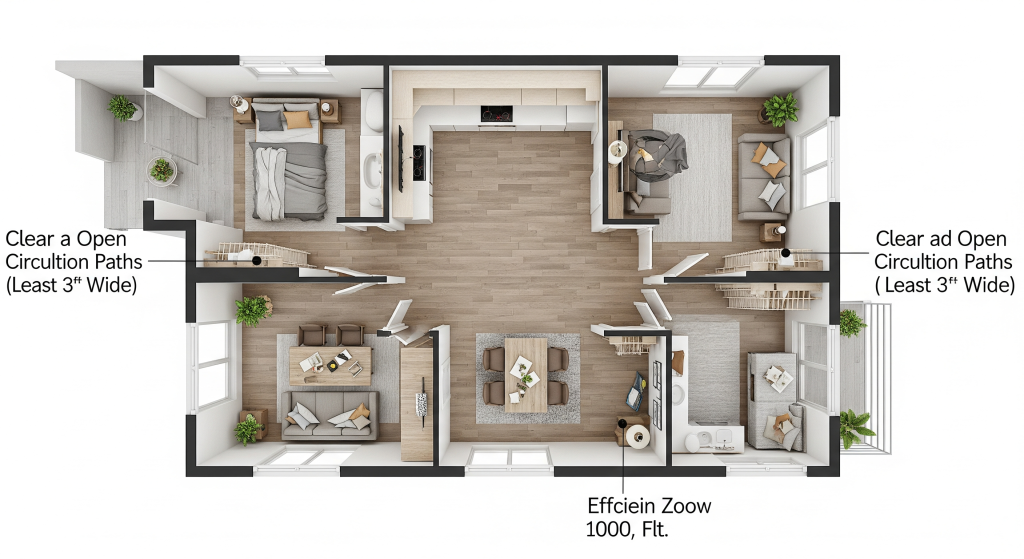
- What: Clears walkways (min. 3 feet wide). Opt for sliding/pocket doors over swing doors.
- Why: Prevents a cramped, frustrating feel. Gets you safe, and easy movement.
4. Multi-Functional Layout
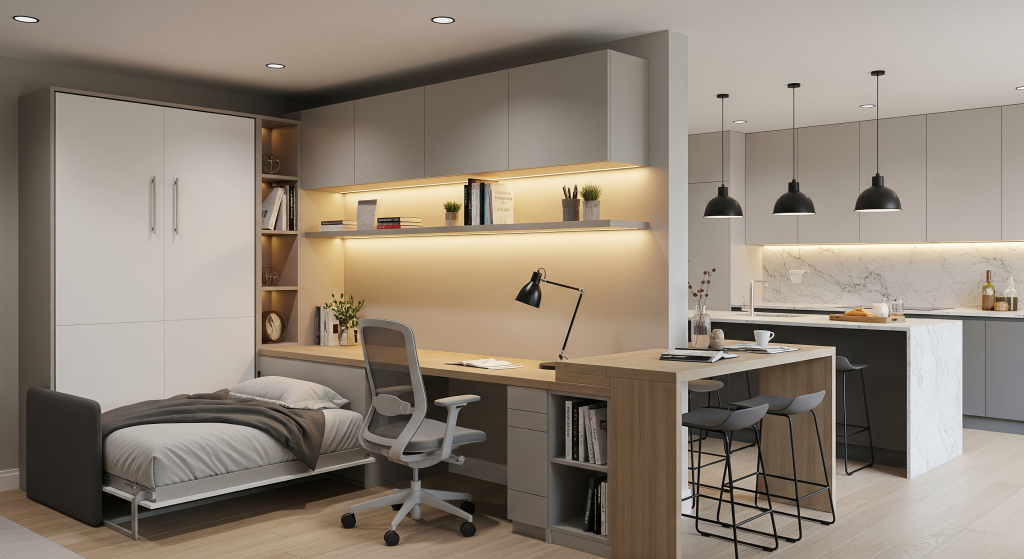
- What: Design rooms for multiple uses (e.g., guest room + study with Murphy bed; kitchen island as dining).
- Why: Maximizes utility of every square foot. Essential for WFH, guests, and adapting to family needs.
5. Balcony is Important
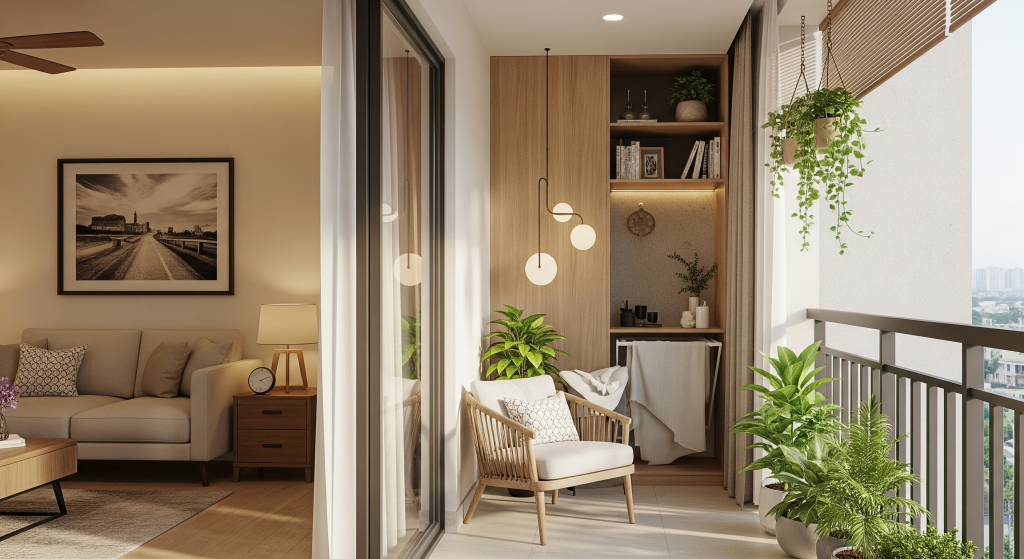
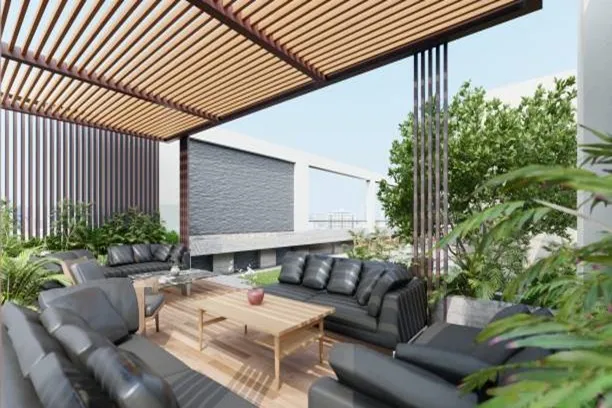
- What: Design it as an integrated room. Plan for dual use: relaxation + utility (drying clothes, plants).
- Why: Provides vital light, air, and mental respite in dense cities. A key space for climate control (ventilation) and well-being.
Maximize Your Home Design in 1000 sq. ft. Room-by-Room
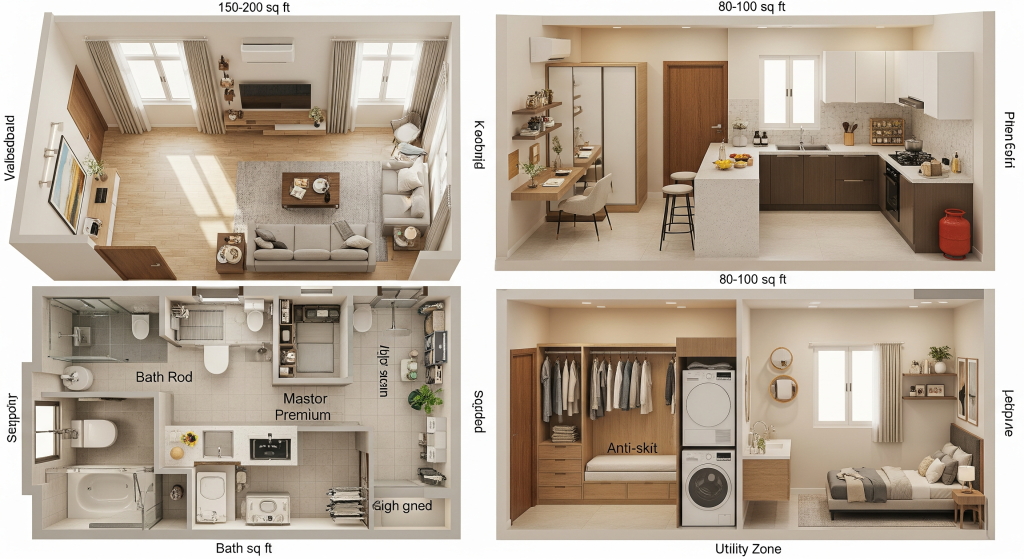
This section provides a detailed, practical breakdown of how to apply space-maximizing strategies to each specific area of your home.
- The Living Room (150-200 sq ft)
Goal: Create a sense of volume.
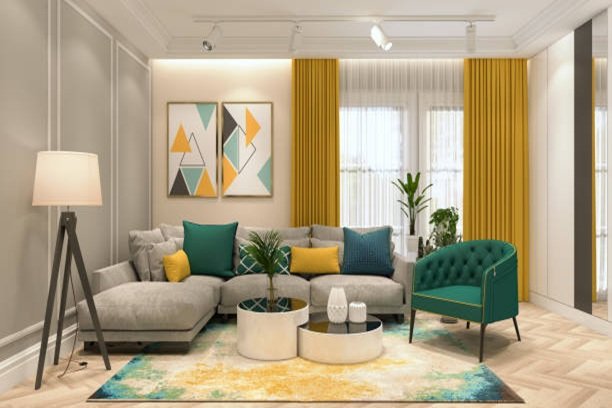
Action: Use a low-profile sofa, wall-mounted unit, and a light colour palette.
Delhi-NCR Must: Install double-glazed windows for heat/noise control. Plan an alcove or concealed space for an air purifier.
Action: Use a low-profile sofa, wall-mounted unit, and a light colour palette.
Delhi-NCR Must: Install double-glazed windows for heat/noise control. Plan an alcove or concealed space for an air purifier.
- The Bedrooms (Master & Secondary)
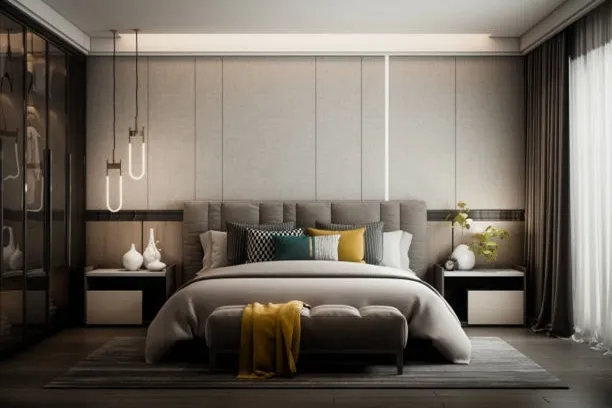
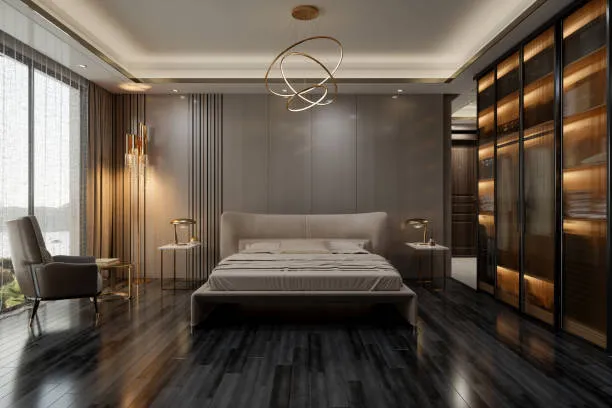
Master: Prioritize a full-height built-in wardrobe with sliding doors.
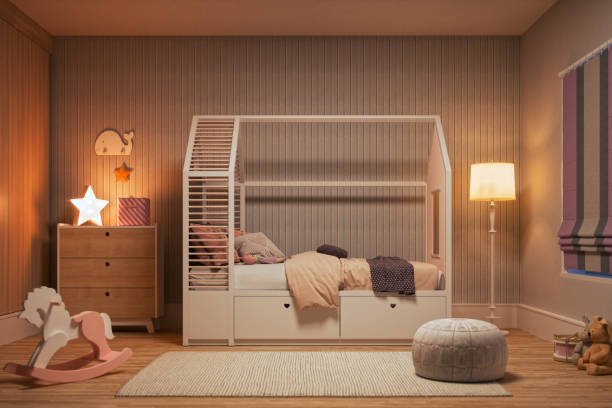
Secondary Bedroom: Adopt the “study-cum-guest” model. Use a wall-mounted desk and a sofa-bed or daybed to serve dual purposes daily.
Secondary Bedroom: Adopt the “study-cum-guest” model. Use a wall-mounted desk and a sofa-bed or daybed to serve dual purposes daily.
- The Bathrooms
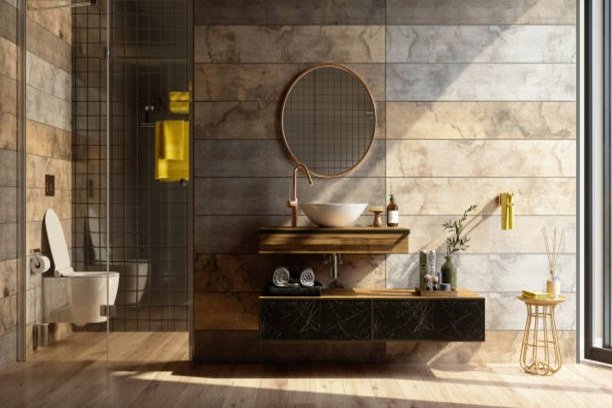
Space-Saver: Use wall-mounted WC and vanity to free up floor space and ease cleaning.
Non-Negotiable: A high-capacity exhaust fan is critical to combat humidity and prevent mould.
Non-Negotiable: A high-capacity exhaust fan is critical to combat humidity and prevent mould.
- The Essential Utility Zone
Must-Have: A dedicated, ventilated enclosure for the washing machine and dryer.
Delhi-NCR Specific: Integrate this with a drying balcony. Use retractable clotheslines and plan for drainage. This hybrid space is essential for laundry management in the region.
Delhi-NCR Specific: Integrate this with a drying balcony. Use retractable clotheslines and plan for drainage. This hybrid space is essential for laundry management in the region.
Right Materials for 1000 sq. ft. Home Interior Design for Durability and Climate
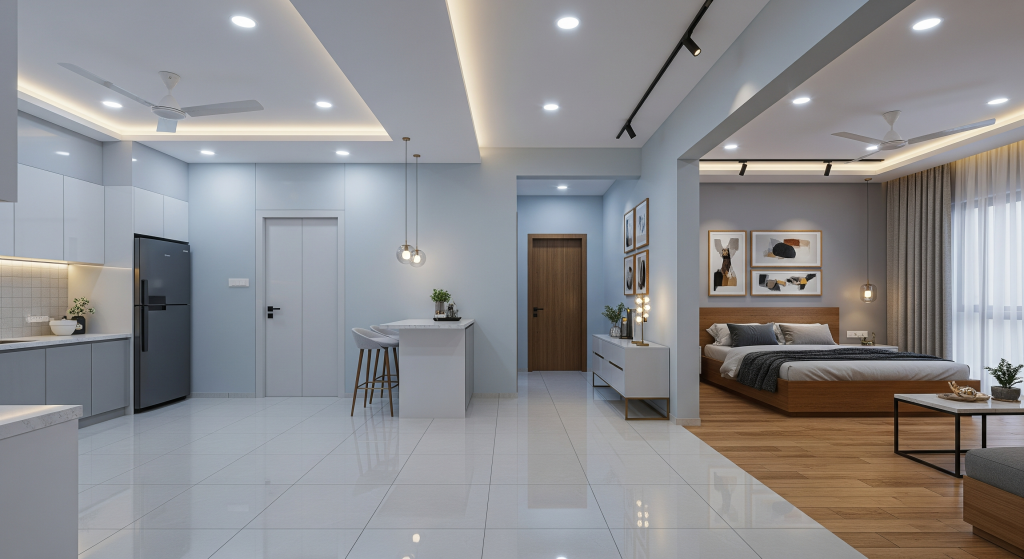
This guide outlines the key material selections for a 1000 sq. ft. home, focusing on durability and climate-appropriate performance for every room.
- Flooring Face-Off
Primary Choice: Vitrified Tiles. Their low porosity makes them highly resistant to stains, scratches, and moisture, ideal for Delhi’s climate and high-traffic areas. They stay cool in summer and are easy to maintain in dusty conditions.
Alternative: Wood-Look Tiles/Engineered Wood. Use in bedrooms for visual warmth and underfoot comfort. Be sure that the product has a high AC rating (abrasion resistance) for durability.
Alternative: Wood-Look Tiles/Engineered Wood. Use in bedrooms for visual warmth and underfoot comfort. Be sure that the product has a high AC rating (abrasion resistance) for durability.
- Paint & Walls
Colour Science: Light, reflective colours (off-whites, light greys) make spaces feel larger and brighter by maximizing light bounce.
Finish & Health: Go for Low-VOC or Zero-VOC paints for better indoor air quality. A scrubbable matte or eggshell finish is essential for wiping away urban dust and pollution residue without damaging the paint.
Finish & Health: Go for Low-VOC or Zero-VOC paints for better indoor air quality. A scrubbable matte or eggshell finish is essential for wiping away urban dust and pollution residue without damaging the paint.
- Ceiling & Lighting
Ceiling: Gypsum plasterboard (POP) ceilings allow for effortless, crack-free finishes and can incorporate recessed lighting. They provide a clean, modern look that makes rooms feel taller.
Lighting: Opt for strategic layered LED lighting. Use recessed lights for overall ambience, task lights (under-cabinet, study lamps) for function, and accent lights (coves, tracks) to highlight features. LEDs are energy-efficient and generate less heat.
Lighting: Opt for strategic layered LED lighting. Use recessed lights for overall ambience, task lights (under-cabinet, study lamps) for function, and accent lights (coves, tracks) to highlight features. LEDs are energy-efficient and generate less heat.
Estimated Budget Breakdown for Delhi NCR (2026)
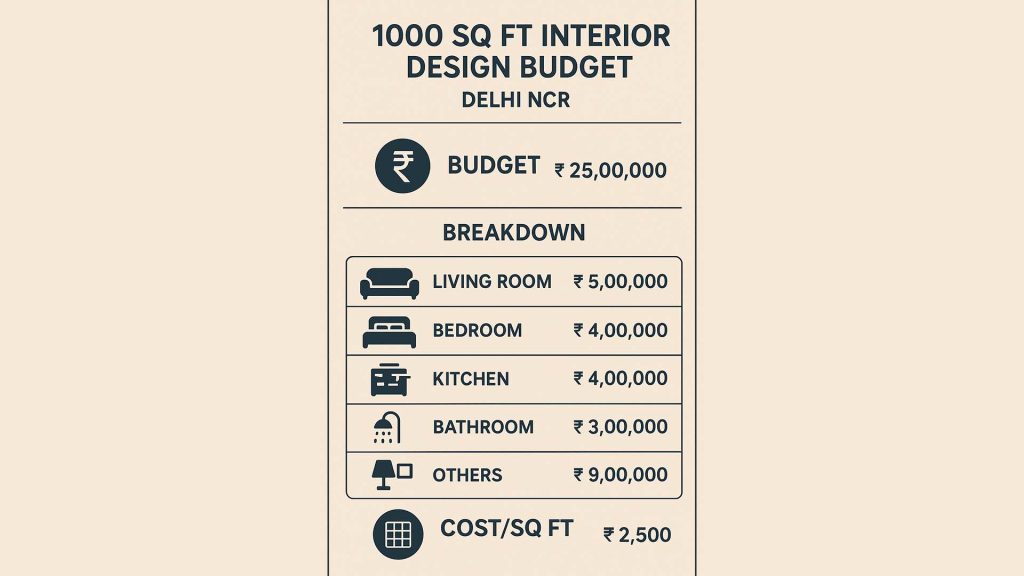
Once your layout is finalized, the next critical step is financial planning. The following is an estimated budget breakdown tailored for the Delhi NCR region in 2026.
Clear Breakdown
Core Construction & Finishes: ₹1,200 – ₹1,800 per sq ft (carpet). This includes civil work, flooring, painting, basic electrical & plumbing.
Key Modular Components:
The Estimated Total Range
The Professional Advice
Core Construction & Finishes: ₹1,200 – ₹1,800 per sq ft (carpet). This includes civil work, flooring, painting, basic electrical & plumbing.
Key Modular Components:
-
- Modular Kitchen: ₹1.5 – ₹3 Lakhs
- Wardrobes & Storage: ₹2 – ₹3.5 Lakhs
- Bathroom Sanitary & Fittings: ₹1 – ₹1.8 Lakhs (for two)
The Estimated Total Range
- For a semi-luxury finish (good quality branded materials, modular furniture, standard fixtures), the total for a 1000 sq ft (~750-850 sq ft carpet) home in Delhi NCR will range between ₹12 – ₹20 Lakhs.
- Critical Note: Always allocate a minimum 10% contingency for unforeseen expenses or upgrades. High-end appliances, decorative lighting, and premium hardware are excluded from this range.
The Professional Advice
- Fee Structure: A professional interior designer typically charges 8-15% of the total project cost.
- The ROI: This fee is an investment that pays for itself by:
- Preventing Costly Errors: Expert space planning avoids structural rework and material wastage.
- Vendor & Contract Management: They negotiate trade rates, manage timelines, and guarantee quality control.
- Long-Term Value: A professionally designed space maximizes functionality and resale appeal. They provide a cohesive plan, saving you time and stress.
How Can Opalspace Help You?
Designing a 1000 sq. ft. home is an exercise in intelligent transformation. It requires in-depth knowledge of smart zoning, vertical strategies, and multi-purpose layouts to unlock profound potential. The design principles discussed above provide the plan to begin that journey yourself. For those seeking a smooth, expert-led renovation, for meticulous space planning, climate-appropriate material selection and flawless execution, our comprehensive interior design services tailor every inch to your vision, delivering a complete, cohesive, and luxurious home.
FAQs
1. What is the most important consideration when planning a home design for 1000 sq ft in Delhi NCR?
The foremost consideration is creating an intelligent open floor plan with defined zoning. In Noida and Delhi NCR, where apartments often have west-facing exposures and dense surroundings, this approach is critical for maximizing natural light penetration and ensuring cross-ventilation to combat heat and pollution. The goal is to merge living, dining, and kitchen areas visually to create a sense of volume, while using furniture or level changes to create distinct functional zones, preventing a single cramped hall feel and improving airflow, a key factor for the region's climate.
2. How can I incorporate sufficient smart and vertical storage in a compact 1000 sq ft apartment?
Smart storage in this context means prioritizing floor-to-ceiling, built-in units over freestanding furniture. Opt for full-height wardrobes with sliding doors in bedrooms, as they save the swing space required by hinged doors. Utilize the often-wasted vertical space above doorways and windows for shallow cabinets to store seasonal items. In kitchens, extend cabinets to the ceiling for less-used appliances and incorporate tall, pull-out units for groceries. This strategy directly counteracts the common clutter issue in Noida's urban apartments by freeing up precious floor space.
3. Why is a multifunctional layout essential for a 1000 sq ft home in Noida, and how is it achieved?
A multifunctional layout is non-negotiable to maximize the utility-per-square-foot ratio, especially for the prevalent nuclear families and professionals in Noida who need dedicated spaces for work, leisure, and guests. This is achieved by designing rooms to serve dual purposes. The most common application is the second bedroom, which should be planned as a study-cum-guest room using a wall-mounted desk and a sofa-bed or Murphy bed. Similarly, a kitchen peninsula can function as a breakfast bar, prep station, and informal dining area, eliminating the need for a separate dining table in a tight layout.
4. What are the specifications for a space-saving modular kitchen and wardrobe in a 1000 sq ft home?
For a modular kitchen, an L-shaped or efficient galley layout is ideal, using high-gloss finishes to reflect light. Specific cabinetry must be designed to neatly house the RO system and gas cylinder, which are essentials in Noida, to avoid unsightly clutter. For wardrobes, full-height, custom-built units with sliding shutter doors are mandatory. Internally, they should combine hanging spaces, deep drawers for Indian wear, and pull-out trays for accessories. The use of mirrored shutters can further enhance the sense of space in the bedroom, making it feel larger and brighter.
5. How should bathroom design be approached in a 1000 sq ft apartment to save space and suit the local climate?
Bathroom design must prioritize space-saving fixtures and superior ventilation. Wall-mounted WCs and vanities create a floating effect, freeing up floor space and making cleaning easier, a boon in hard water areas like Delhi NCR. The single most critical element is installing a high-capacity exhaust fan to combat the high humidity, which is essential to prevent mould and moisture damage. Materials should be non-porous, such as ceramic or vitrified tiles for walls, to handle the humidity and ensure easy maintenance in the region's dusty environment.