
This blog explains what PVC panels are and how PVC wall ceiling panels work in homes, including their benefits, installation cost in India, and where they are commonly used.
Table of Contents
Home interiors across India have changed rapidly in the last few years. Faster renovation methods and practical materials now guide many interior decisions. One material gaining strong attention is the PVC wall ceiling panel.
Your thinking is on the right path with PVC in wall panel designs. They bring an elegant, modern touch to your master bedroom and to the rest of your house. They are versatile, less expensive than other materials, and will last for many years. They come in a variety of textures, patterns, and colours to maximise design options.
Your thinking is on the right path with PVC in wall panel designs. They bring an elegant, modern touch to your master bedroom and to the rest of your house. They are versatile, less expensive than other materials, and will last for many years. They come in a variety of textures, patterns, and colours to maximise design options.
What is a PVC Panel?
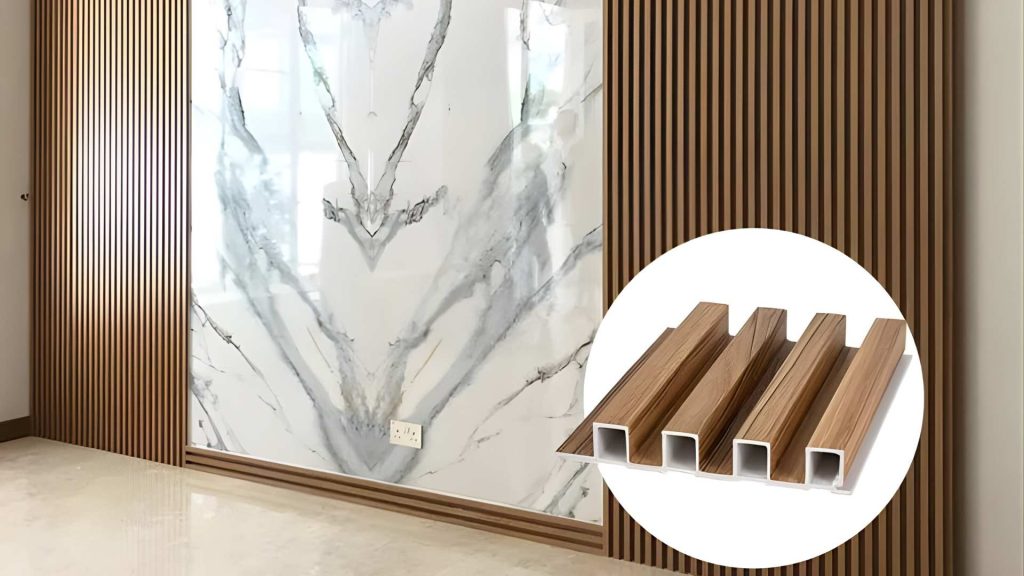
A PVC panel is what we use for a Polyvinyl Chloride panel. It is a lightweight, waterproof sheet of rigid plastic. We use them to cover walls and ceilings out with a great-looking, durable surface. PVC panels are also prefinished in the factory, have a large range of textures and colours, and may be put up directly over present walls without removing them. They are very much at home in Indian homes, offices, and commercial spaces due to their affordable price point, easy maintenance and their ability to resist water.
How Do PVC Panels Work for Walls and Ceilings?
PVC panels are made from polyvinyl chloride resin, which is mixed with stabilisers and additives. We put the material into a form of hollow panels, which at the same time becomes lightweight yet very durable. The hollow structure, which reduces weight, also makes installation easy, which is why many contractors push for the use of PVC for quick home renovations.
Material Structure of PVC Panels
Typical PVC panels include:
- PVC polymer base
- Hollow core interior
- Laminated or printed decorative finish
- Locking grooves for installation
How Are PVC Ceilings Installed?
PVC ceiling installation is easy.
- We install a metal or wood-based frame on the ceiling.
- Then the PVC panels are put in the frame that has interlocking joints.
- Edge trims are used to secure the panel edges.
- Also, we make cutouts for light fixtures and fans.
What Are the Main Advantages of PVC False Ceilings for Homes?
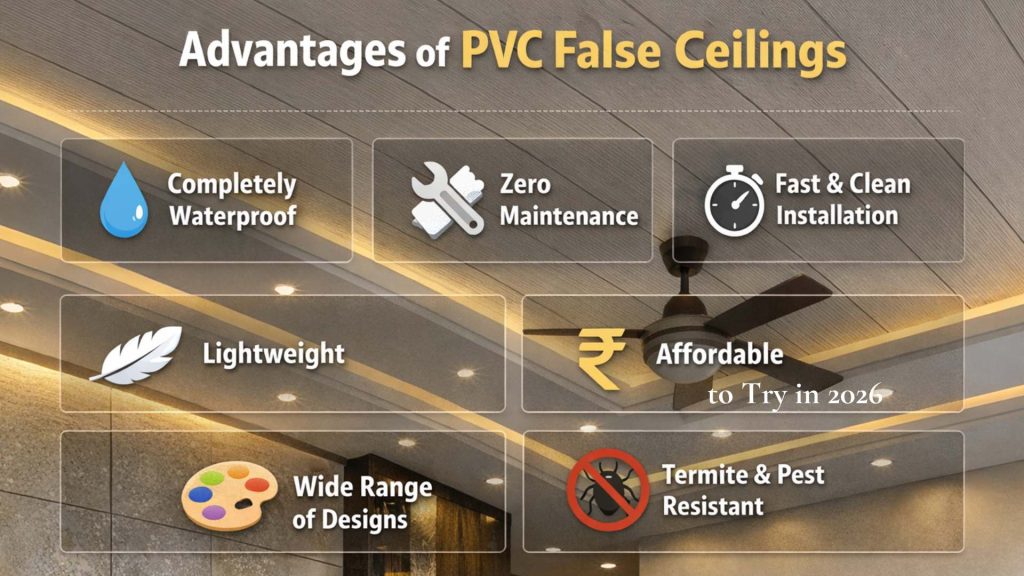
PVC ceilings gained popularity because of the practical benefits that suit Indian homes.
1. Completely Waterproof
PVC doesn’t take in water. What makes it the best material for balconies, basements, bathrooms, and kitchen interiors is its performance in constant moisture. Also, unlike gypsum, PVC panels won’t sag or crack here.
2. Zero Maintenance
They do not require any work after installation, like painting, polishing or reapplying finish. Instead, they will just need to be wiped with a damp cloth to look as good as new. For busy families, students and bachelors, that is a major plus point of choosing PVC over plaster or wooden panels.
3. Fast and Clean Installation
PVC panels are cut with a saw and fixed using adhesive or a clip-track system. No wet mixing, no drying time, no dust beyond the cutting. A standard bedroom ceiling can be done in a single day. This is a huge advantage if you are a tenant doing light renovation or a homeowner who cannot afford a lengthy site disruption.
4. Lightweight
PVC panels are about 60–70% lighter than gypsum boards of similar size. This puts less stress on the false ceiling design and makes the installation of the production into older buildings easier and safer.
5. Affordable
PVC panels are a popular choice for economical interior finishes in India today. We see large-scale domestic production of these, which in turn keeps prices down for the budget-conscious buyer.
6. Wide Range of Designs
You can get PVC panels with 3D textures for gloss marble imitation, wood look finishes, plain white, and anything in between. With the hundreds of design options available, you can create your desired look in your interiors without the cost of real wood and stone.
7. Termite-Proof and Pest-Resistant
PVC is also free of all organic matter, so unlike wood and particleboard, PVC is of no interest to termites, rodents, or insects. This is especially important for older buildings and ground-floor houses in humid Indian cities.

Cost of PVC Ceiling Installation Per Square Foot in India
One of the most searched questions about PVC ceilings is the installation cost. Here is a realistic breakdown for prices in the Delhi NCR and broader North Indian market:
| Component | Estimated Cost (₹ per sq ft) |
|---|---|
| PVC panels material (standard) | ₹35 – ₹60 |
| PVC panel material (premium/3D) | ₹65 – ₹120 |
| Aluminum framework/grid | ₹20 – ₹35 |
| Labour charges | ₹20 – ₹40 |
| Total (standard install) | ₹75 – ₹135 |
| Total (premium install) | ₹105 – ₹195 |
For a 120 sq ft bedroom ceiling, you have to spend ₹9,000 – ₹23,000 depending on panel quality and city. These numbers are lower than a comparable gypsum false ceiling with POP finishing, which typically runs ₹120 – ₹200 per sq ft, including labour in Delhi NCR.
PVC vs WPC vs Gypsum: Material Comparison
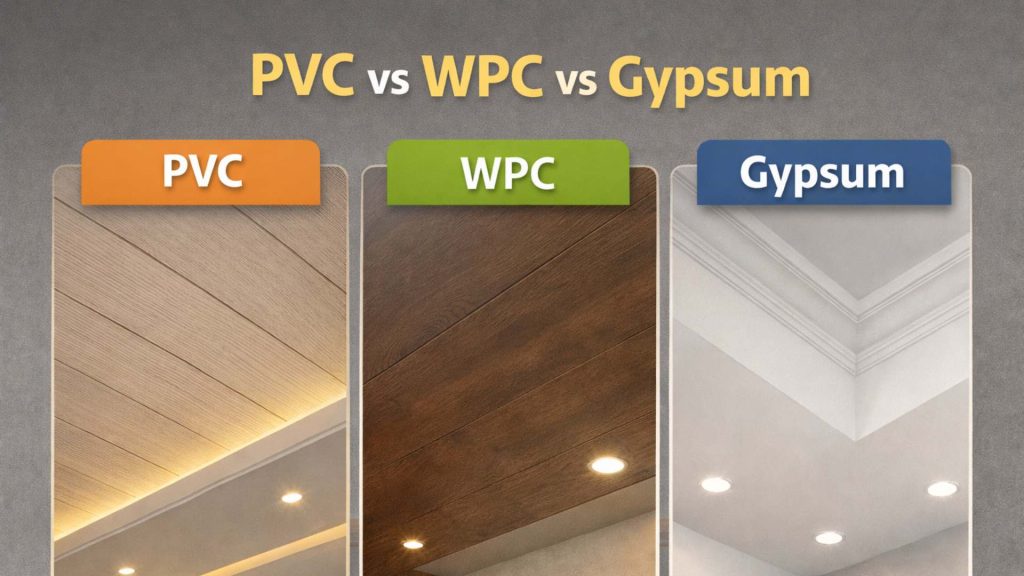
This is the question most homeowners and renovators ask. Here’s a side-by-side breakdown across the factors that matter:
| Factor | PVC Panels | WPC Panels | Gypsum |
|---|---|---|---|
| Full Form | Polyvinyl Chloride | Wood-Plastic Composite | Calcium Sulphate Board |
| Water Resistance | Fully Waterproof (Excellent) | Water resistant (Good) | Absorbs moisture (Poor) |
| Weight | Very Light | Moderate | Moderate to heavy |
| Durability | 10–15 years typical | 15–20 years typical | 8–12 years with care |
| Fire Resistance | Can melt/burn (Low) | Moderate | Naturally fire resistant (High) |
| Cost (Material) | ₹35–₹120 / sq ft | ₹80–₹180 / sq ft | ₹40–₹90 / sq ft |
| Installation | Very easy, DIY possible | Moderate | Requires skilled labour |
| Maintenance | Very Low | Low | Moderate, needs repainting |
| Termite Resistance | Yes | Yes | No, susceptible |
| Design Options | Very Wide | Wide | Limited, paint only |
| Best Use | Bathrooms, Kitchens, Halls | Outdoor, Semi-outdoor, premium interiors | Living rooms, bedrooms, and AC spaces |
Which Is Better for Your Home: PVC or Gypsum?
Gypsum false ceilings have been the standard choice in Indian homes for two decades. PVC is now challenging that position, and for good reason.
Gypsum Advantages
- Excellent fire resistance, Gypsum naturally suppresses flames.
- Smooth paintable surface, preferred for living rooms and bedrooms where a plastered look is desired.
- Supports complex shapes, curved, coffered, and multi-level designs are easier with gypsum.
- Better acoustic performance in some configurations.
PVC Advantages Over Gypsum
- Waterproof, Gypsum ceilings in bathrooms and kitchens crack, sag, and grow mould over time.
- No repainting required, Gypsum needs periodic touch-up, PVC does not.
- Faster installation, PVC saves days of site work compared to Gypsum + POP finishing.
- Lower total cost in most standard applications.
- Better for rental properties and budget renovations.
How Can Opalspace Help You?
PVC panels are a choice for today’s Indian interior design because of their water-resistant quality, easy installation, and low maintenance, which in turn makes it a great option for kitchens, bathrooms and budget revamps. Also, when it comes to WPC and gypsum, we see that each has what the other doesn’t in terms of durability, design and cost.
For homeowners planning interior upgrades, Opalspace provides smart solutions for walls and ceilings, along with a wide range of interior design services in Noida for complete home spaces.
For homeowners planning interior upgrades, Opalspace provides smart solutions for walls and ceilings, along with a wide range of interior design services in Noida for complete home spaces.
FAQs
1. What is a PVC panel used for?
PVC panels are used to cover interior walls and ceilings as a decorative and protective surface. They are commonly installed in living rooms, bedrooms, kitchens, bathrooms, and offices.
2. Are PVC panels good for homes?
Yes, PVC panels are suitable for homes because they are waterproof, lightweight, easy to install, and require very little maintenance.
3. What is the cost of PVC ceiling installation per square foot in India?
PVC ceiling installation usually costs between ₹75 and ₹195 per square foot, depending on panel quality, design, and labour charges.
4. How long do PVC panels last?
PVC panels typically last 10 to 15 years or longer when installed properly and maintained with basic cleaning.
5. Can PVC panels be used in bathrooms?
Yes, PVC panels are commonly used in bathrooms because they are completely waterproof and resistant to moisture.