
Table of Contents
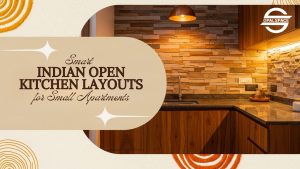
The advantage is that it fosters connection and efficient use of space. The key is to achieve this along with addressing practical aspects like efficient ventilation, smart storage for Indian utensils, and strategic layout to manage cooking aromas. Let’s explore design ideas that harmonize this modern layout with the specific needs and rhythms of contemporary Indian living.
Indian Open Kitchen Design Ideas to Steal
Category A: The Architectural & Zoning Ideas
1. Open Kitchen Partition Ideas: Sliding & Folding Glass Partitions

A tempered glass partition (sliding or folding) seals off cooking smells and grease while preserving visual openness. It’s the optimal compromise for Indian kitchens, allowing containment during heavy frying or tempering, and openness otherwise.
- Material: The unit is constructed from 8-12mm thick toughened safety glass.
- Finish Options: Frosted glass is available to provide privacy.
- Operation Styles: It is available in two styles: a top-hung sliding system with a polished finish and a wall-mounted folding system for maximum opening.
- Integration: The design allows it to be neatly packed into walls or concealed behind cabinetry.
- Critical Note: This unit is not a replacement for a chimney; it is designed to work alongside a powerful exhaust system with a capacity greater than 1200 m³/hr to make ventilation more effective within the enclosed space.
- Best For: This product is best suited for families who need a physical barrier against cooking odours without installing permanent walls.
2. Zone-Defining Kitchen Peninsula

A kitchen peninsula is a countertop extension from a wall or cabinet forming a “T” or “G” shape. It naturally demarcates the kitchen from living areas, providing a psychological and visual boundary.
- Containment: It helps hide the kitchen mess from the living area view.
- Utility: It adds significant storage, seating (with overhang), and prep space without occupying the floor space required for a full island.
- Dual-Sided Design: The kitchen side is for function, while the living room side can feature decorative finishes or open shelving.
- Space-Efficient: It is ideal for smaller layouts where a central island is not feasible.
- Standard Depth: The standard depth is 60cm for the workspace, extending to 90cm-1m if seating is included on both sides.
- Overhang: An overhang of 30-35cm is recommended for comfortable knee clearance with stools.
- Clearance: You should maintain at least 90cm of walkway between the peninsula and any opposite counters.
3. In-Kitchen Vertical Zoning
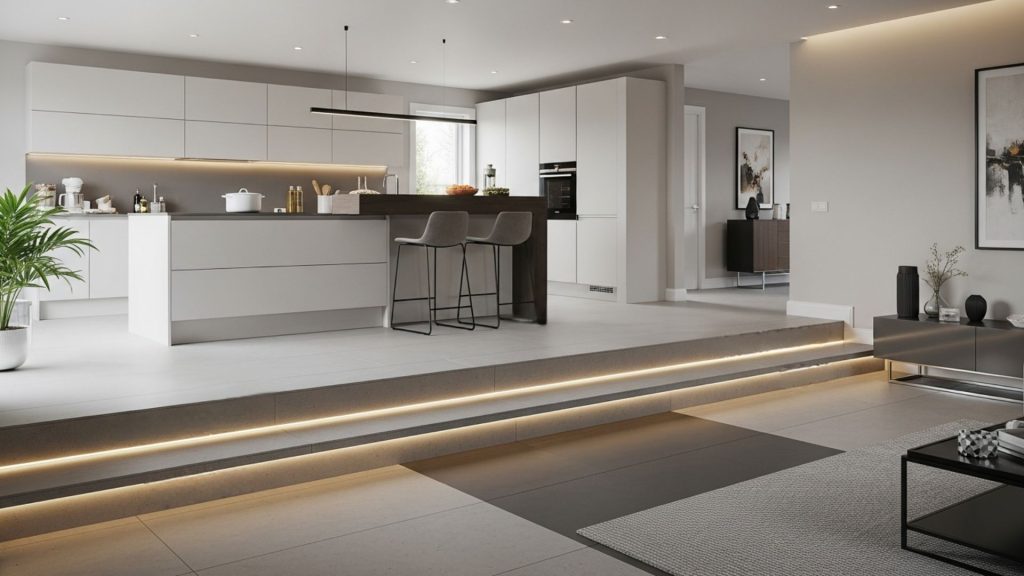
If you use elevation for storage and kitchen cabinets, it creates subtle, architectural separation and leaves no visual blockage. In fact, it subconsciously defines zones.
- Multi-Level Island: This design incorporates a higher section (110-115cm) to hide sink or prep clutter and a standard section (90cm) for cooking or seating, adding visual interest and creating clear functional zones.
- Raised Living Area Floor: This involves a platform that creates a 5-15cm step up to elevate and distinguish the living or dining zone, which can use the same flooring for flow or a different material for emphasis.
- Safety: For raised floors, integrated step lighting (such as LED strips) is essential, and the step height should ideally be 10-15cm to minimize tripping hazards.
- Structural: Raised floors must be planned during the initial slab stage, as retrofitting them later is complex.
- Accessibility: This design is not suitable for wheelchair users or individuals with mobility concerns.
- Best For: These applications are best suited for custom builds and larger homes seeking high-end, architectural definition within an open-plan layout.
Category B: The Style & Decor Ideas (Visual Cohesion)
4. Built-In Material for Continuous Flooringring
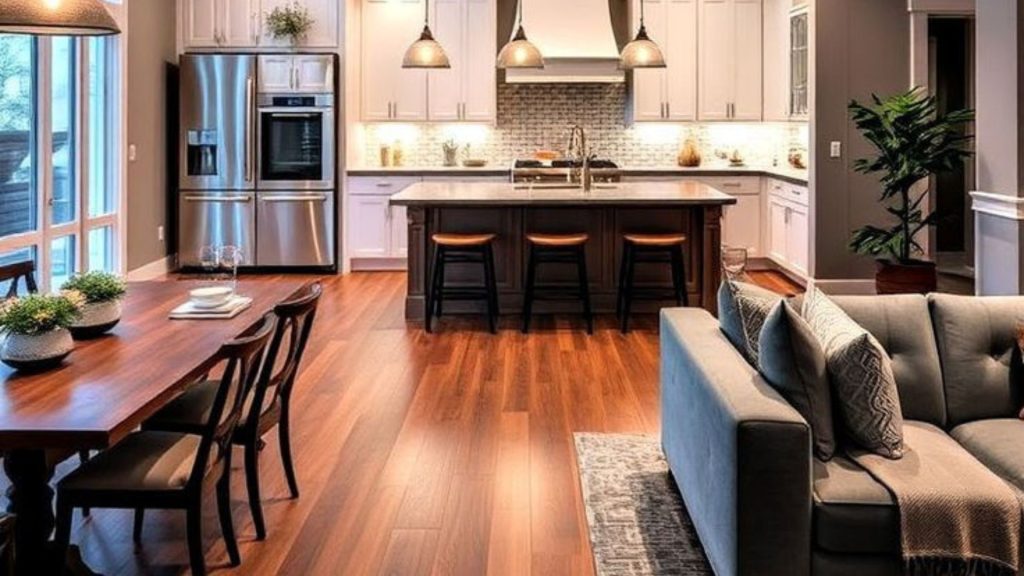
A consistent flooring material, such as large-format porcelain tiles, vinyl planks, or micro-topped cement, extended from the kitchen into adjoining areas creates a visual continuum. This smooth flow erases boundaries and makes the entire space feel larger and cohesive.
- Material Choice: You need to select low-porosity, high-stain-resistance materials, such as porcelain tiles (through-body or rectified), which are ideal for kitchen spills and high living-area traffic.
- Format & Layout: To enhance a polished look, you need to use large-format tiles or planks with minimal grout lines and lay them parallel to the longest wall to amplify the sense of length.
- Functional Note: A consistent finish, such as matte or textured, is necessary throughout for uniform slip resistance and ease of maintenance, and you should avoid high-gloss finishes in kitchen areas prone to wetness.
- Visual Trick: A continuous floor gives way to furniture and area rugs for defining zones without the floor itself becoming a visual interrupter.
5. Strategic and Thoughtful Cabinet Accents
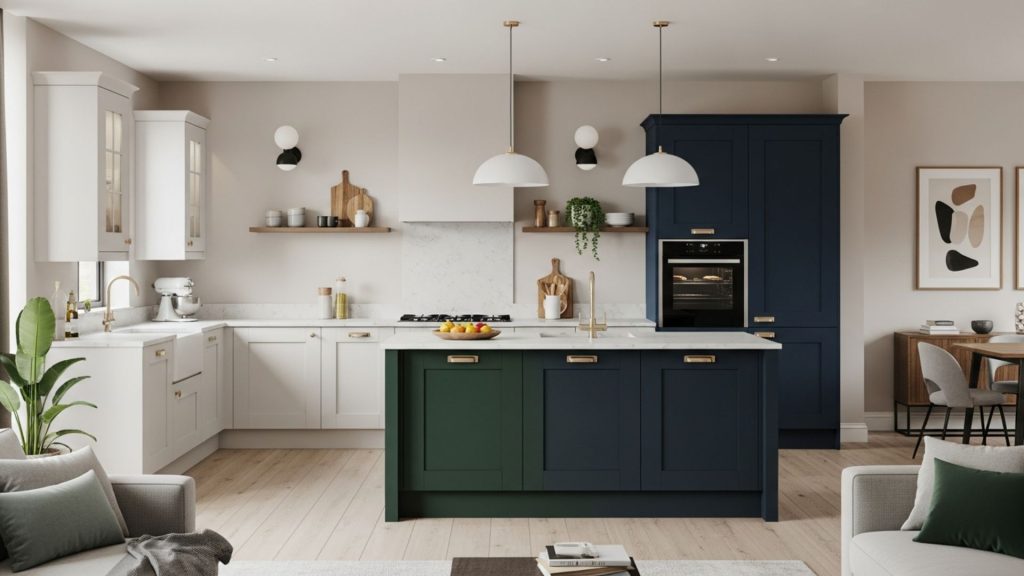
This technique uses a bold, saturated colour on the kitchen cabinetry (e.g., deep blue, emerald green, terracotta, or matte black) against a neutral backdrop in the living area (whites, beiges, greys) to visually lead the kitchen as a distinct zone.
- The 60-30-10 Rule: You should apply the accent colour to approximately 30% of the total open-plan volume, primarily on base cabinets, an island, or a full tall unit, with the remaining 60% in neutral tones and 10% as metallic or secondary accents.
- Colour Psychology: Warm tones, such as reds and oranges, stimulate appetite and social energy, while cool tones like blues and greens promote calm and cleanliness.
- Cohesion is Key: You can create an intentional colour thread by pulling one subtle colour from the kitchen accent into the living area via cushions, artwork, or a single piece of furniture.
- Material Integration: The bold cabinet colour should complement fixed materials like countertops and flooring and not clash with them; a neutral countertop typically works best with bold kitchen cabinet designs.
6. Open Kitchen Ceiling Design
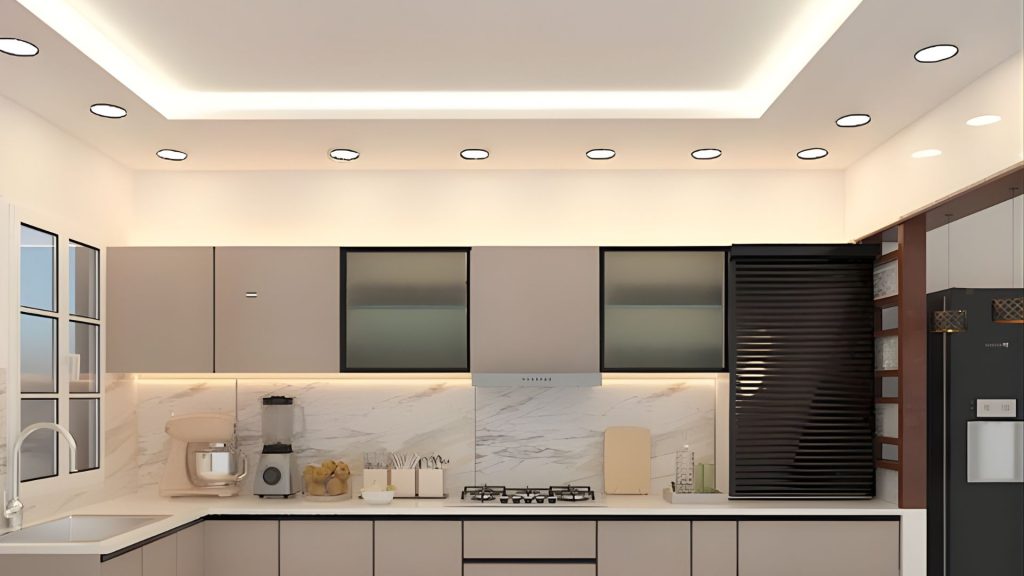
Kitchen ceiling designs conceal essential but unattractive elements like wiring, ducts, pipes, and structural beams. It draws the eye up or down, and restores balance and focus visually. Altering the ceiling design or height over the kitchen zone is a highly effective method in open concept kitchen designs.
- Dropped or Tray Ceilings: This treatment involves installing a false ceiling lowered by 6-12 inches over the kitchen perimeter or island, which can house recessed task lighting, ambient coves, and ductwork for a clean look.
- Coffered or Beam Ceilings: These ceilings add dimensional depth; you can use simple, functional beams to frame the edge of the kitchen area.
- Colour & Finish: You can define the space by painting the kitchen ceiling a darker shade, such as a warm grey, or using a different material like wood veneer or tin tiles compared to the white living-area ceiling.
- Ceiling Height: This design requires a minimum original ceiling height of 9.5-10 feet to avoid a cramped feel after installing a dropped section.
- Lighting Integration: The design must accommodate both general ambient lighting for the overall space and focused kitchen task lighting within the dropped section.
- Ventilation Path: The design should not obstruct the ducting path from the chimney to the exterior, as it often runs through the ceiling void.
Category C: The Smart & Practical Indian Open Kitchen Design Ideas
7. Down Draft Solution
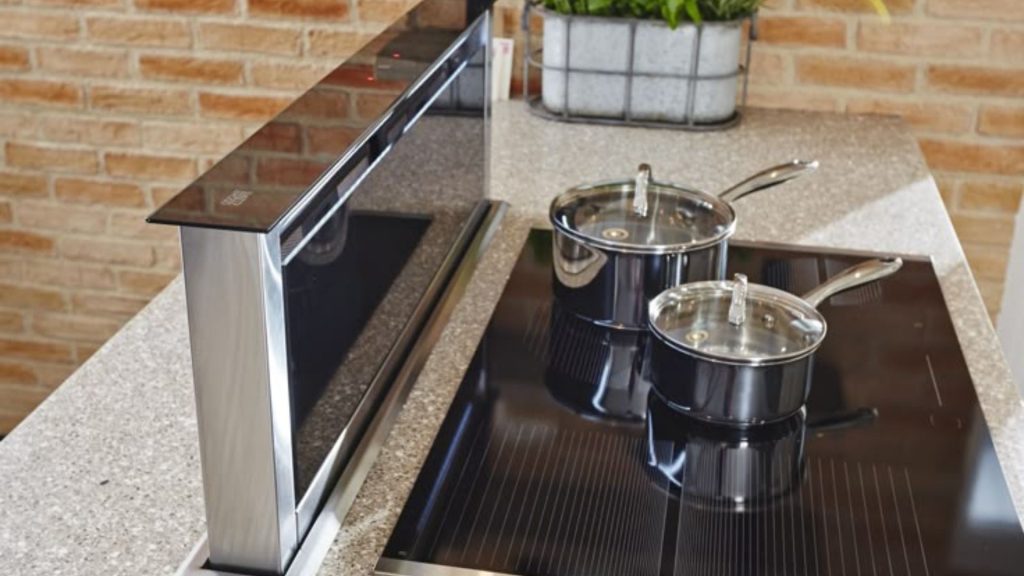
A downdraft cooktop has a built-in ventilation system that rises from behind the cooking surface and sucks smoke, steam, and grease downwards, exhausting it through ducts under the floor or through cabinetry. It’s the only aesthetically clean solution for a kitchen island.
- Functionality: The fan power is rated in CFM (Cubic Feet per Minute), for Indian cooking, a minimum of 600-700 CFM is required. Note that downdraft systems are generally less powerful than overhead chimneys of equivalent CFM due to physics (fighting rising heat).
- Ideal Use Case: Best for light to moderate cooking. It is highly effective for grilling, sautéing, and low-oil cooking.
- Critical Limitations: Struggles with vigorous tempering (tadka) or deep frying, as the rapid plume of dense smoke can overwhelm the suction. Requires careful placement near an exterior wall to minimize long, complex ducting runs.
- Installation: Must be planned during the slab/flooring stage for under-floor ducting. Also, it adds significant cost.
- Best For: Island-centric designs with light-cooking habits, often used as a secondary cooktop.
8. The Concealed Kitchen (Kitchen-Within-a-Kitchen)

- Closure Types: Pocket doors (sliding into walls) for an attractive look, bi-fold panels for heavy-duty closures, sliding barn-style doors for aesthetic charm.
- Materials: Panels can match cabinetry (for camouflage), use tinted or frosted glass, or feature decorative finishes (wood, metal) to become a feature wall when closed.
- Integrated Services: All services (plumbing, electrical, major ducts) remain within the concealed box. The visible area may feature only an elegant counter, an integrated fridge, and closed storage.
- Space Requirement: This Indian open kitchen concept needs extra wall depth (10-15cm) for pocket door channels, reducing usable space.
- Ventilation: The enclosed kitchen must have its own powerful, ducted chimney to function safely when closed.
- Cost & Complexity: One of the most expensive and structurally involved options, requiring meticulous early-stage planning with an architect.
- Best For: Studio apartments, homes with frequent gatherings and entertainment, ideal for small apartments like 1BHK flats.
9. Masala & Frying Station
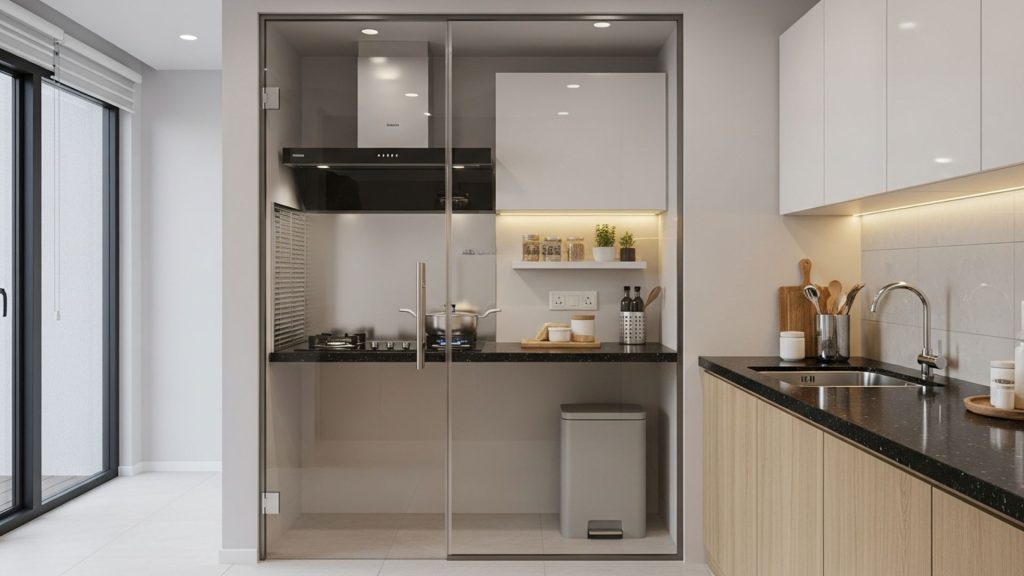
An enclosed, super-ventilated mini-zone within or adjacent to the open kitchen, specifically designed to contain high-odour, high-smoke, and high-splatter Indian cooking techniques.
- Physical Enclosure: A floor-to-ceiling glass or solid partition with a door, or a deep alcove with a raised lip on the counter, acts as a splash and smell barrier.
- Targeted Ventilation: Equipped with a dedicated, high-power chimney (minimum 1500 m³/hr) directly above, generally with a deep, efficient hood or a top-angled capture panel.
- Practical Surfaces: Non-porous, easy-clean materials like stainless steel cladding, ceramic/glass splashbacks, and granite countertops. Includes a dedicated, sealed trash bin for peels and waste.
- Strategic Placement: Ideally located closest to an exterior wall for the shortest, most efficient duct run to maximize suction power. It usually accommodates the gas burner used most for tadka.
Category D: Open Kitchen Ideas for Modern Small Apartments
10. Space-Illusion Mirror

Reflective surfaces have a tendency of drawing a perception of depth and doubles visual space in a small kitchen.
- Full Mirror Backsplash: A floor-to-countertop mirror behind appliances visually pushes the wall back. It is recommended to use only toughened glass fixed with proper adhesive. Keep it impeccably clean.
- Glossy Metro Tiles: High-gloss, light-coloured subway tiles (in a stacked bond pattern) reflect light better than matte finishes. They amplify brightness and sense of space.
- Strategic Placement: Apply only to one primary wall (typically behind sink/cooktop). You must avoid opposing mirrored walls because it causes confusing infinite reflections.
- Safety & Practicality: Make sure that the mirrors are not placed behind active cooking gas burners due to heat and splatter. A hybrid approach uses mirror on upper half and easy-clean tiles behind the hob.
- Best for: Narrow, galley-style kitchens with limited natural light.
11. Multitasking Kitchen Island Design (Mobile)
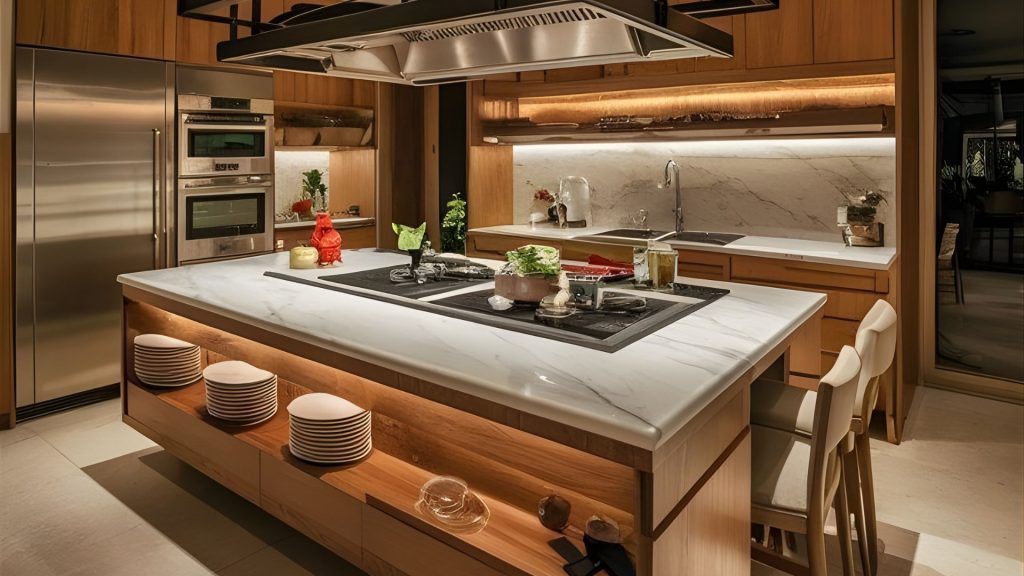
A compact, wheeled kitchen cart/butcher block that provides flexible extra counter space, storage, and seating without permanent installation.
- Dimensions: Typically, 60-80cm wide, 40-50cm deep. Height should match standard counter height (90cm) or be slightly higher (100cm) for a standing buffet.
- Castor Wheels: These wheels can be locked for stability during use. They are special wheels that can be rolled around easily but have a lock switch to turn them into fixed legs when you need the island to stay perfectly still and safe for chopping, cooking, or eating.
- Multi-level Surface: A main solid wood or laminate prep top, with a fold-down side or extension leaf for seating (requires 25-30cm overhang).
- Smart Storage: Open shelving below for baskets, a towel bar on the side, and a small drawer for utensils.
- Utility: Movable kitchen island serves as a prep station, breakfast bar, serving cart, or additional storage. It can be tucked against a wall when not in use.
- Best for: Renters or small apartments where permanent islands are impossible, adds flexible functionality, ideal for 1BHK layouts.
12. Vertical Kitchen Storage
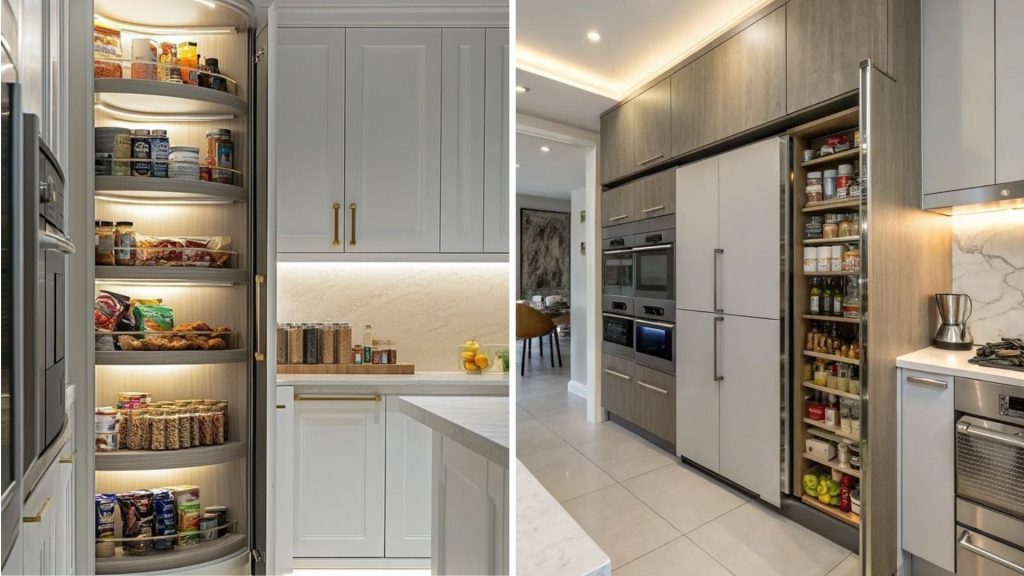
This approach is critical in small flats/apartments. It makes full use of the wall space from floor to ceiling, which helps keep the floor area free in a small home or compact apartment.
- Floor-to-Ceiling Cabinets: You can make use of tall units (up to 2.4m or higher) for pantry storage, and integrate pull-out tall ladders or slim step stools for access.
- Layered Storage: Upper cabinets go all the way to the ceiling to eliminate dust-collecting gaps. Use the topmost shelf for rarely used items.
- Strategic Open Shelving: Replace a few upper cabinet doors with open shelves (30-35cm deep) for daily-use items and visual lightness. Keeps counters clear.
- Appliance Strategy: Opt for slimline or built-in appliances. It is helpful to use in-cabinet or over-cabinet mounts for microwaves.
- Critical Rule: Maintain the triangle workflow between sink, fridge, and cooktop even with vertical focus. Do not over-clutter walls.
- Best for: All small kitchens, essential for single-wall layouts.
13. Single-Wall + Kitchen Peninsula
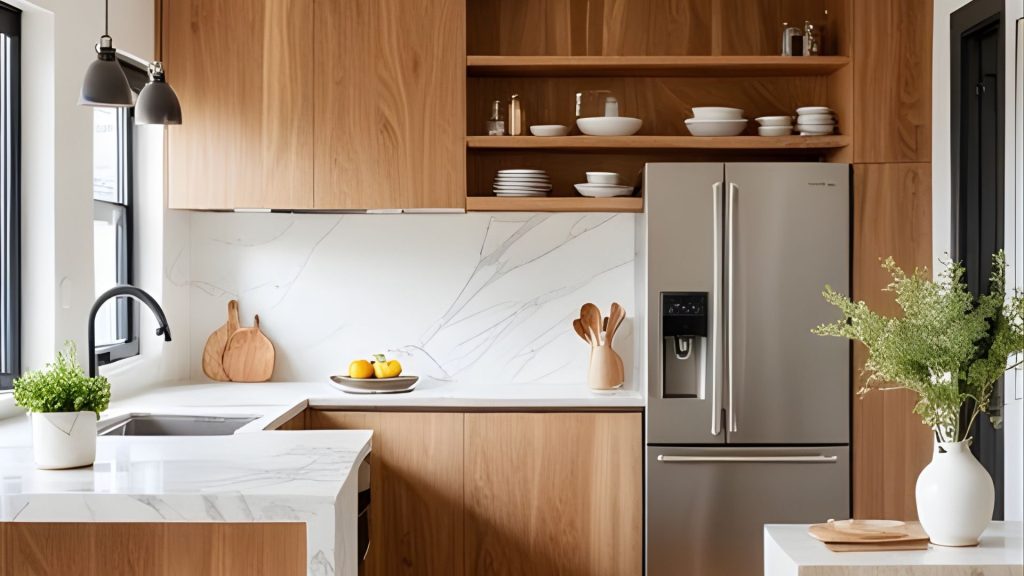
The most efficient layout for small-spaces: all appliances/cabinets on one wall, with a countertop extension (peninsula) perpendicular at the end for a methodical separation and seating.
- Standard Single-Wall Layout: Requires a minimum linear length of 3 meters to fit fridge, sink, and cooktop with adequate counter space between.
- The Peninsula Extension: Extends the countertop 60-90cm into the room, forming an ‘L’ or a ‘T’. Its back becomes a visual barrier hiding kitchen clutter.
- Dimensions: Peninsula depth is 60cm (standard counter) with a 30-35cm overhang on the living side for stool seating. Maintain at least 90cm clearance between peninsula and opposite wall/furniture.
- Functional Gain: Adds critical prep surface, informal dining for 2-3, and defines the kitchen zone without closing it off. Houses additional storage below.
- Best for: Narrow rectangular apartments (studio or 1BHK) where space width doesn’t allow parallel counters. It is the space-efficient upgrade from a plain single-wall kitchen, top choice for small apartment layouts.
Additional Open Kitchen Layouts with Living Room
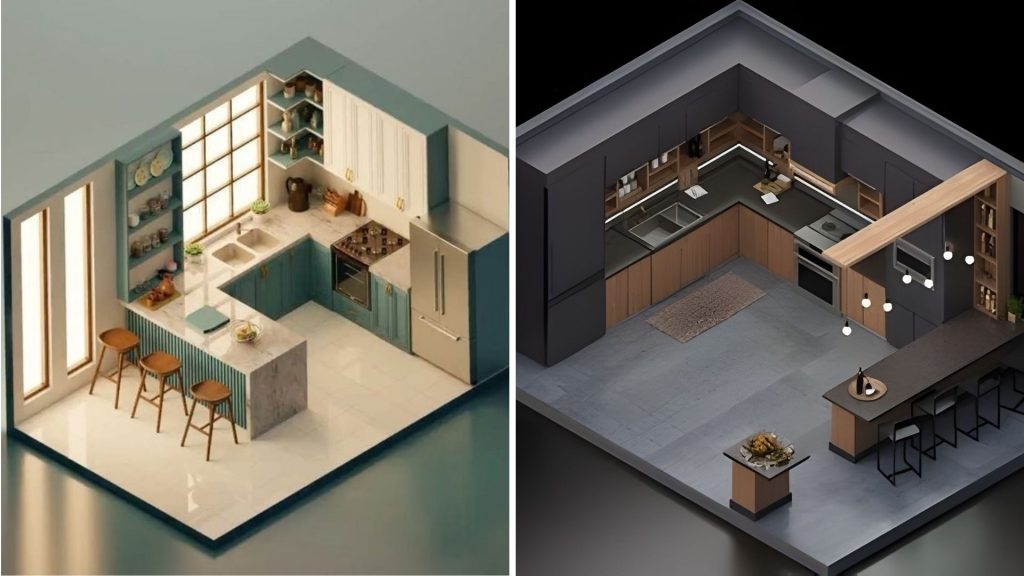
For small apartments, merging an open kitchen with the living room in an Indian setup simply means no wall between them. So you can cook, chat, and watch TV all at the same time. It makes the whole space feel bigger, brighter, and much more social.
- L-Shape: Ideal for corner spaces. Requires two adjacent walls. Ensure the work triangle (sink-fridge-cooktop) has legs between 1.2m and 2.7m each.
- U-Shape: Maximizes storage and counter space. Needs three walls. Maintain a minimum central floor space of 1.2m x 1.2m for safe, comfortable movement.
- Single-Wall + Peninsula: Best for narrow rooms. The peninsula extends from the main wall, creating a natural divider. The peninsula should be at least 60cm deep and have 90-105cm clearance from any opposite surface.
- Galley-with-Peninsula: A parallel counter layout with one side opened into a peninsula facing the living area. Highly efficient for workflow.
- Primary Rule: The layout must prioritize an unobstructed workflow while defining the kitchen’s zone within the open plan.
Open Kitchen Door/Entrance Design
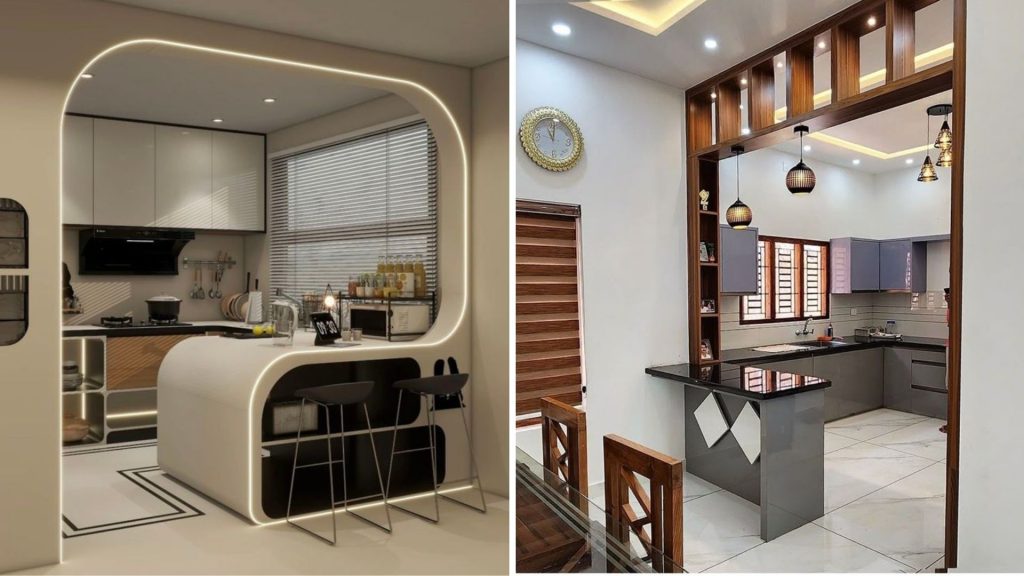
Latest Open Kitchen Door Design Strategies (2025-2026):
- Pocket Doors: Slide completely into the wall, hiding to achieve a full opening.
- Barn Doors: Slide on an exposed track, deliver rustic impact as a design feature.
- Glass Partitions: Large, often frameless glass panels that slide, provide a sound/smell barrier without blocking light or sightlines.
- Bifold/Multi-Fold Doors: Fold like an accordion to open wide openings fully, great for merging indoor/outdoor kitchens.
- Pass-through Windows: Counter-height openings with windows that lift up or slide horizontally to open or close the pass-through.
How Can We Help You?
Our team provides tailored design and expert planning for a customized 3D layout perfect for your space and lifestyle. We handle end-to-end project execution, managing contractors and sourcing the right materials, and deliver comprehensive interior design services to guarantee your entire home is cohesive, functional, and beautifully reflects you.